What to Confirm Before Ordering SF6 Gas Equipment
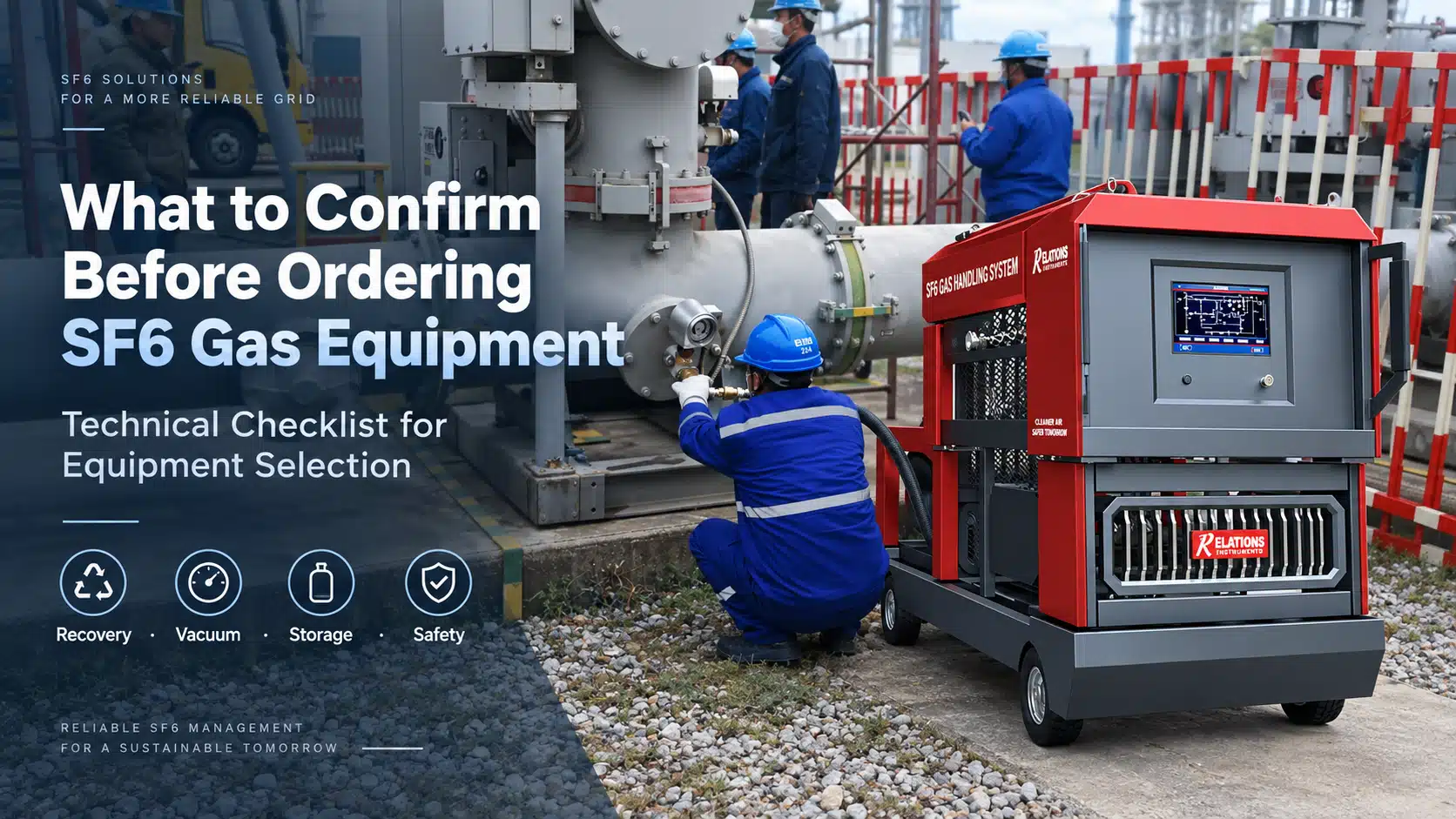
Start with the application requirements, not the equipment specifications.
Before purchase, confirm the gas volume, recovery target, storage method, switchgear connection, power supply, and applicable standards. These requirements determine the compressor, vacuum pump, storage tank, hoses, couplings, and control system you need.
1. Define the Application
First, define the required functions.
Typical functions include:
- SF6 recovery;
- gas-compartment evacuation;
- SF6 refilling;
- gas transfer;
- temporary gas storage;
- filtration or gas conditioning.
Different applications require different types of SF6 gas equipment.
SF6 Gas Handling Carts
An SF6 gas handling cart may include:
- oil-free compressor;
- vacuum pump;
- filtration system;
- storage tank;
- hoses and couplings;
- weighing system;
- manual or PLC control.
Typical compressor capacities range from about 4 to 38 m³/h. Vacuum pump capacities may range from about 17 to 64 m³/h.
Select the capacity based on gas volume and the required service time.
SF6 Refilling Devices
Portable SF6 refilling devices are mainly used to transfer gas from cylinders into gas compartments.
Typical components include:
- pressure regulator;
- filling hose;
- pressure gauge;
- cylinder connection;
- self-sealing coupling.
For these devices, connection compatibility and pressure control usually matter more than high flow rate.
SF6 Storage Tanks
Common storage sizes include:
| Tank Volume | Typical SF6 Filling | Design Pressure |
|---|---|---|
| 300 L | Approx. 280 kg | 50 bar |
| 600 L | Approx. 580 kg | 50 bar |
| 1,000 L | Approx. 980 kg | 50 bar |
Select the tank based on the required gas capacity, operating pressure, and applicable pressure-vessel requirements.
2. Confirm Applicable Standards
Specify the applicable standards and editions in the purchase documents.
Common references include:
| Standard | Main Application |
|---|---|
| IEC 60376 | Technical-grade SF6 for electrical equipment |
| IEC 60480 | Re-use specifications for SF6 and its mixtures |
| IEC 62271-4 | Handling procedures for insulating gases |
| GB/T 12022 | Industrial sulfur hexafluoride |
| DL/T 662 | SF6 filling and recovery equipment |
Do not apply technical-grade gas limits to recovered SF6.
The supplied reference lists IEC 60376 values for technical-grade SF6 including:
- SF6 ≥ 99.7% by volume;
- air < 2,000 µL/L;
- CF4 < 800 µL/L;
- H2O < 200 µL/L.
For SF6 intended for re-use, the supplied IEC 60480:2019 reference includes:
- SF6 > 97% by volume;
- air/CF4 < 30,000 µL/L;
- H2O < 200 µL/L;
- mineral oil < 10 mg/kg;
- total acidity < 50 µL/L.
Clearly state the gas category, applicable standard, and acceptance limits in the purchase specification.
3. Check Compressor Performance
SF6 gas equipment used for recovery should use an oil-free compressor to help prevent oil contamination.
Confirm:
- compressor type;
- displacement;
- maximum working pressure;
- inlet and outlet pressure range;
- cooling method;
- protection functions.
Compressor displacement alone does not determine recovery speed.
Actual performance is also affected by:
- compartment pressure;
- hose diameter and length;
- valve and coupling resistance;
- filter resistance;
- storage pressure;
- gas temperature.
Ask the supplier to state the recovery rate and the test conditions used to verify it.
4. Confirm Vacuum and Recovery Performance
Evacuation and gas recovery are different operations.
The vacuum pump removes air and moisture before filling. The recovery circuit removes SF6 from the gas compartment and transfers it to storage.
Confirm:
- vacuum pump capacity;
- achievable evacuation pressure;
- recovery end pressure.
Typical vacuum pump capacities in the supplied references range from about 17 to 64 m³/h.
High-performance recovery systems may specify a recovery end pressure below 1 mbar.
Do not confuse vacuum pump ultimate pressure with SF6 recovery end pressure.
5. Check Filtration and Gas Quality
Typical SF6 filtration systems may reduce:
- moisture;
- particles;
- selected decomposition products.
Molecular sieve filtration is commonly used to remove moisture and contaminants.
However, filtration does not automatically mean that recovered gas meets a technical-grade gas specification.
Analyze the recovered SF6 after filtration or reclaiming.
IEC 60480 uses a decision process based on gas condition, contamination, treatment, storage, and final analysis.
Specify the filtration capability and gas-quality acceptance criteria separately.
6. Confirm Storage Capacity
Before selecting a storage tank, determine the maximum amount of SF6 that may be recovered during a single job.
Check:
- tank volume;
- maximum filling mass;
- design pressure;
- safety valve;
- pressure gauge;
- liquid or gaseous storage capability;
- weighing system;
- pressure-vessel certification.
Some systems provide digital weighing with an accuracy of about ±0.4 kg.
Confirm the actual weighing range and accuracy with the supplier.
7. Check Couplings, Hoses, and Adapters
Confirm connection compatibility before placing the order.
Common connection sizes may include:
- DN6;
- DN7;
- DN8;
- DN12;
- DN20.
The exact connection depends on the installed switchgear.
Self-Sealing Couplings
SF6 self-sealing couplings help reduce gas release during connection and disconnection.
They also reduce air ingress and improve gas tightness.
To minimize SF6 emissions, confirm that the equipment and hoses use gas-tight, self-sealing couplings.
Hose Size
Typical configurations may include:
- DN19 recovery hose, about 10 m;
- DN13 filling hose, about 5 m.
Long or undersized hoses increase flow resistance and can reduce recovery speed.
8. Confirm Emission-Control and Safety Features
SF6 gas equipment should be designed to minimize gas release during recovery, transfer, connection, and disconnection.
Key features include:
- gas-tight piping;
- self-sealing couplings;
- low-leakage valves;
- controlled gas recovery;
- low recovery end pressure.
Some manufacturers specify an annual leakage rate of ≤1%. If this is required, ask for the test method and conditions.
Safety features may include:
- overpressure protection;
- pressure switches;
- non-return valves;
- storage tank safety valve;
- emergency stop;
- phase-sequence protection;
- automatic shutdown.
For indoor work, ensure adequate ventilation and follow site procedures for handling SF6 and possible decomposition products.
9. Confirm Power Supply and Site Conditions
Check the electrical supply before ordering SF6 gas equipment.
A common configuration is:
- three-phase;
- five-wire;
- AC 380 V ±10%;
- 50 Hz.
Other voltages and frequencies are also common, depending on the market.
Confirm:
- site voltage;
- frequency;
- phase configuration;
- available electrical capacity.
Also check the required operating environment.
A typical specification may state:
- temperature: −10°C to +40°C;
- relative humidity: below 85%, without condensation.
Select the equipment based on the actual site conditions.
10. Select the Right Control Level
SF6 gas equipment may use:
- manual control;
- PLC control;
- touch-screen control;
- remote monitoring.
Automation can control recovery, evacuation, gas transfer, alarms, and pressure monitoring.
Choose the control level based on operating frequency, process complexity, and operator needs.
11. Confirm Mobility
For substations or sites with limited access, check:
- equipment dimensions;
- total weight;
- wheel design;
- lifting points;
- modular construction;
- forklift access;
- vehicle loading.
A modular SF6 recovery device can be useful where a complete unit cannot reach the gas compartment.
12. Check Documentation and Support
Before ordering SF6 gas equipment, confirm that the supplier can provide the required technical documents.
These may include:
- operating manual;
- maintenance instructions;
- electrical drawings;
- piping diagrams;
- spare-parts list;
- equipment certificates;
- pressure-vessel documents;
- calibration certificates where applicable.
Also confirm:
- warranty period;
- spare-part availability;
- filter replacement requirements;
- technical support;
- operator training.
Pre-Order Checklist for SF6 Gas Equipment
| Item | What to Confirm |
|---|---|
| Application | Equipment type and gas volume |
| Standards | Applicable IEC and local standards |
| Compressor | Oil-free type and required capacity |
| Vacuum | Pump capacity and final evacuation pressure |
| Recovery | Required recovery end pressure |
| Filtration | Moisture, particle, and contaminant removal |
| Gas quality | Test method and acceptance limits |
| Storage | Tank size, pressure rating, and filling mass |
| Couplings | Compatibility with existing switchgear |
| Hoses | Correct diameter, length, and connection type |
| Emission control | Self-sealing couplings and low leakage |
| Safety | Overpressure protection and emergency stop |
| Power | Voltage, frequency, and phase |
| Controls | Manual, PLC, touch screen, or remote |
| Mobility | Size, weight, and transport method |
| Documentation | Manuals, certificates, and drawings |
| Support | Warranty, training, and spare parts |
Confirm the Requirements Before Ordering
Before ordering SF6 gas equipment, confirm the operating conditions that directly affect equipment selection: gas quantity, recovery pressure, evacuation target, storage capacity, connection type, power supply, applicable standards, and site conditions.
These requirements determine the appropriate compressor capacity, vacuum performance, storage configuration, hoses, couplings, controls, and safety features.
A clear technical specification also makes it easier to compare suppliers on the same basis and reduces the risk of selecting equipment that does not match the application.
If you are selecting SF6 gas equipment for a GIS, circuit breaker, substation, or maintenance project, send us your gas volume, equipment type, required recovery pressure, power supply, and connection details through . Our technical team can help review the application and recommend a suitable configuration.