What Affects SF6 Evacuation Time?
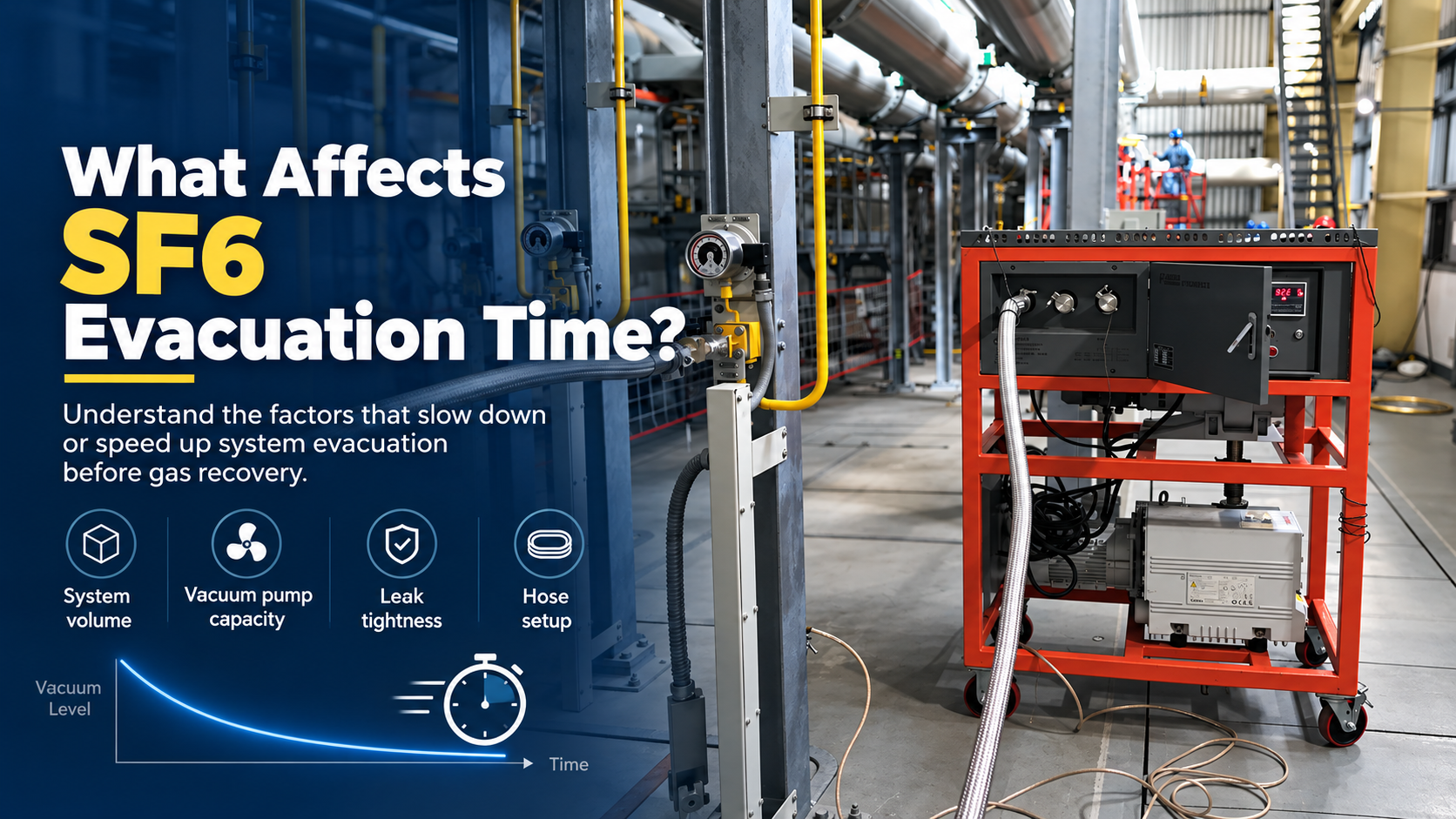
SF6 evacuation time depends on much more than vacuum pump size. System volume, target vacuum, gas path resistance, leakage, moisture, and pump performance all affect the process. These factors work together, so similar systems can require very different evacuation times.
Understanding these differences helps maintenance teams plan SF6 handling work more accurately. It also reduces unnecessary waiting during recovery, maintenance, testing, and refilling. The goal is not simply faster evacuation. The goal is reliable vacuum performance within a practical maintenance window.
What Is SF6 Evacuation Time?
SF6 evacuation time is the time required to reach and verify the specified vacuum condition. It can apply to a gas compartment, pipeline, storage vessel, or connected gas path. Pump running time alone does not define completion.
Two systems can run equally long and still reach different vacuum levels. Volume, hose configuration, pump capacity, leakage, and moisture can all change evacuation performance. The actual vacuum condition should therefore remain the main acceptance criterion.
What Factors Affect SF6 Evacuation Time?
Several factors influence evacuation time together. Pump capacity matters, but the complete evacuation system determines actual performance.
| Factor | Effect on Evacuation Time | What to Check |
|---|---|---|
| System volume | Larger volumes usually require more time | Compartment, piping, tank, connected volume |
| Vacuum pump performance | Higher effective capacity can shorten evacuation | Pump condition and pumping speed |
| Hose diameter and length | Long or narrow hoses restrict flow | Hose size, length, fittings |
| Target vacuum | Lower pressure usually requires more time | Required vacuum condition |
| Leakage | Incoming air slows pressure reduction | Couplings, valves, seals, joints |
| Moisture and gas release | Additional gas load extends evacuation | Cleanliness, dryness, air exposure |
System volume determines how much gas the pump must remove. Larger compartments and connected piping usually require more time. Hoses, manifolds, and tanks can also increase the total volume. The main compartment may therefore represent only part of the evacuation load.
Vacuum pump performance must be considered together with the gas path. Rated pumping speed does not equal effective pumping speed at the system. Hoses, valves, fittings, and other restrictions reduce gas flow before it reaches the pump. Long hoses and small internal diameters can become major bottlenecks. A large volume with a narrow hose may evacuate slowly, even with a larger pump.
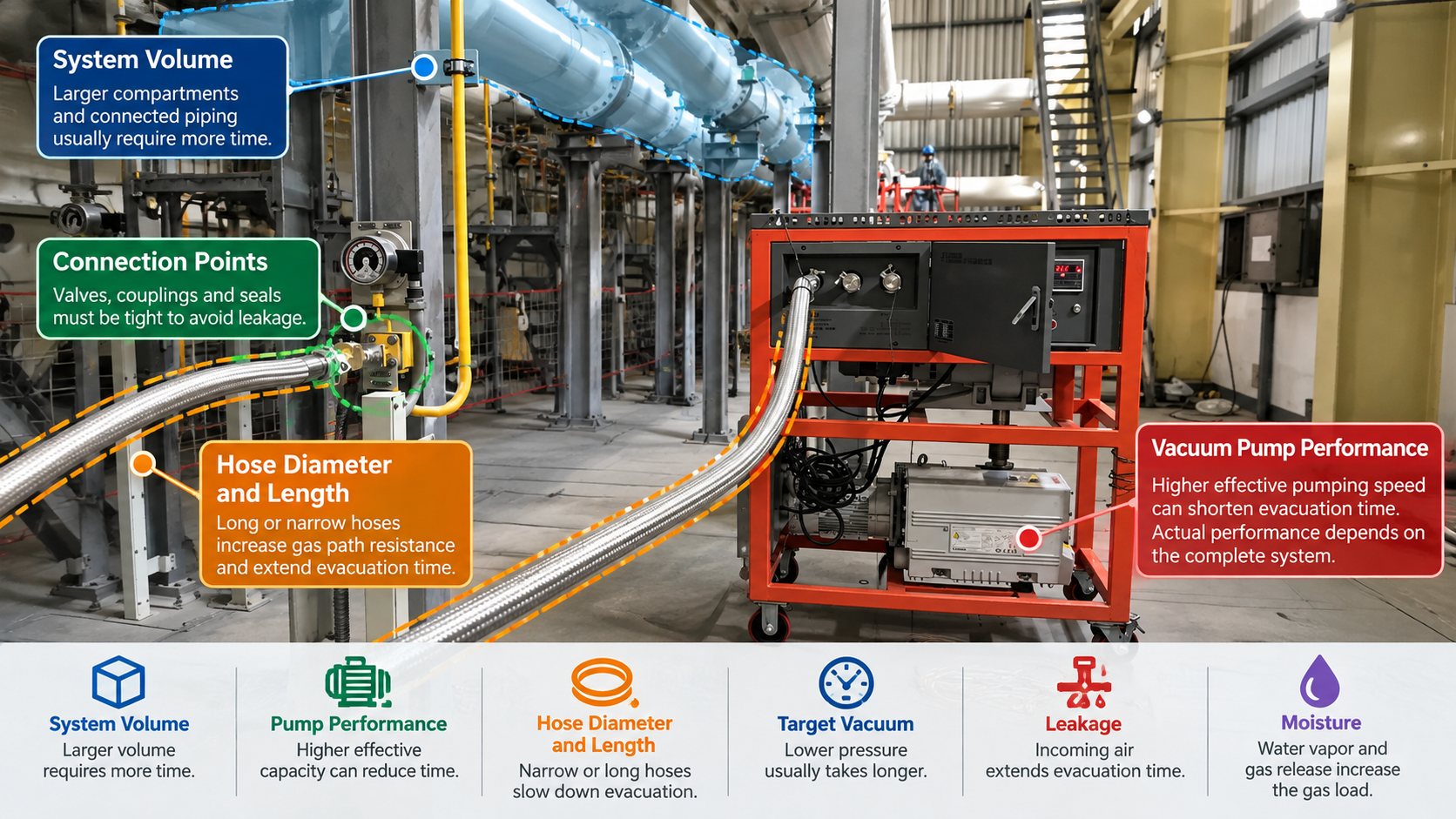
Target vacuum also affects total evacuation time. Lower absolute pressure usually requires more time to reach. No single vacuum value applies to every SF6 system. Operators should follow the equipment procedure, manufacturer requirement, or project specification.
Leakage and moisture can further extend the process. Leaks continuously add air while the pump removes gas. Moisture and gases from internal surfaces also increase the remaining gas load. These effects become more important near the target vacuum. Clean components and secure connections help reduce unnecessary delays.
Why Does Evacuation Slow Down Near the Target Vacuum?
Pressure often falls quickly at first and then slows near the target vacuum. Early in the process, the system contains a large amount of free gas. The pump can remove this gas relatively quickly.
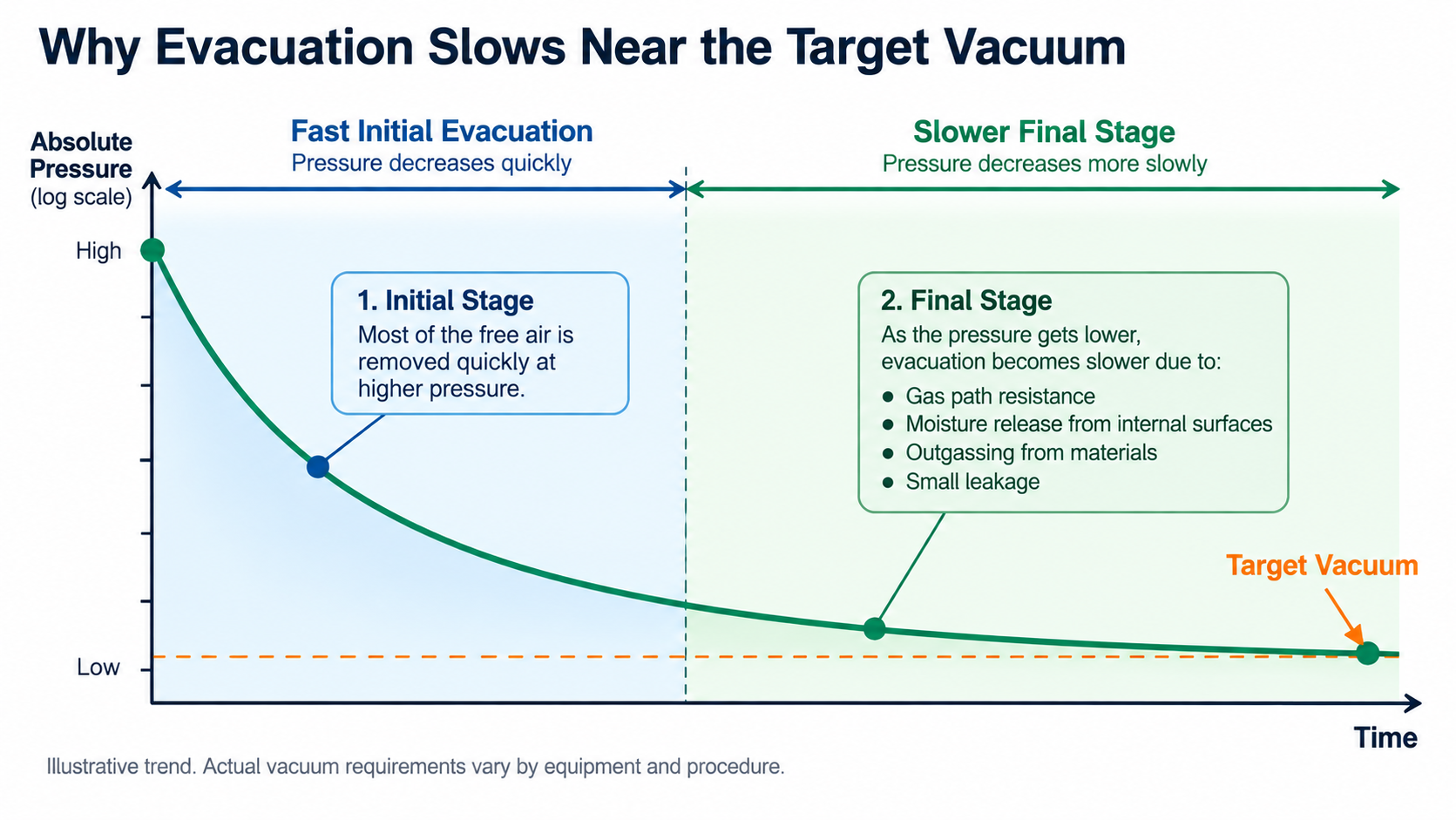
As pressure falls, gas path resistance becomes more important. Fittings, valves, leakage, moisture release, and outgassing can also affect the final stage. The last part of evacuation may therefore require a large share of the total time.
This behavior explains why a larger vacuum pump cannot solve every slow evacuation problem. A restrictive hose can limit effective pumping speed. Leakage and moisture can also reduce the benefit of higher pump capacity.
Vacuum stability gives operators useful information after reaching the target pressure. A significant pressure rise may indicate leakage, retained gas, moisture release, or other gas sources. However, a vacuum stability check does not replace a dedicated leak test.
How Does Evacuation Time Affect Maintenance Efficiency?
Evacuation affects the timing of recovery, maintenance, testing, and refilling. Slow evacuation can extend equipment downtime and delay the next maintenance step. Unexpected delays also make the entire service schedule harder to manage.
Predictable evacuation performance makes maintenance planning easier. A suitable pump and practical hose layout can reduce unnecessary waiting. Secure connections and correct valve positions also improve process consistency.
Faster is not always better. Stopping too early may save time but leave the system outside the required condition. Maintenance efficiency should come from better system design, not from reducing the vacuum requirement.
How Can You Reduce SF6 Evacuation Time?
The first step is to identify the real bottleneck. Increasing pump capacity without correcting other restrictions may produce little improvement.
| Cause of Delay | Practical Action | Why It Helps |
|---|---|---|
| Incorrect pump capacity | Match pump performance to system volume | Provides suitable evacuation capacity |
| High gas path resistance | Use suitable hose diameter and length | Improves gas flow |
| Leakage | Check hoses, couplings, valves, and seals | Reduces continuous air entry |
| Moisture | Keep hoses and components clean and dry | Reduces water vapor and gas release |
| Poor valve alignment | Confirm the correct flow path | Prevents restrictions and isolated sections |
| Unreliable measurement | Measure at a representative system point | Confirms actual system vacuum |
| Fixed-time operation | Use the specified vacuum condition | Avoids premature or unnecessary evacuation |
A larger pump can help when pump capacity limits the process. However, hose resistance may remain the main restriction. Leakage can create another bottleneck, while moisture can extend the final stage. The best improvement usually comes from optimizing the complete evacuation path.
Operators should also avoid relying on fixed evacuation times. Two systems can run equally long and reach different conditions. The specified vacuum condition should remain the main endpoint.
Choosing the Right SF6 Evacuation Equipment
SF6 evacuation time reflects the performance of the complete evacuation system. Pump capacity is only one part of that system. System volume, target vacuum, hose layout, leakage, moisture, and operating conditions also affect the result. A suitable setup should reach the required vacuum without unnecessary waiting.
Equipment selection should match the actual maintenance task. Consider system volume, required vacuum, hose layout, evacuation frequency, portability, and the available maintenance window. The goal is not simply to shorten SF6 evacuation time. The goal is to reach the required vacuum faster without compromising vacuum quality. A well-matched setup reduces maintenance downtime and improves overall SF6 handling efficiency.
For help selecting SF6 vacuum or gas-handling equipment, contact [email protected] with your operating requirements.
Frequently Asked Questions
How long does SF6 evacuation normally take?
There is no single standard time. Volume, target vacuum, pump performance, hose resistance, leakage, and moisture all affect evacuation time.
Does a larger vacuum pump always reduce SF6 evacuation time?
No. Hose resistance, valves, leakage, and moisture can limit effective pumping speed at the system.
Why does vacuum pressure rise after evacuation?
Leaks, retained gas, moisture release, outgassing, or temperature changes can raise pressure. A pressure rise does not always indicate leakage.