Why Oil-Free Compressors Matter in SF6 Recovery
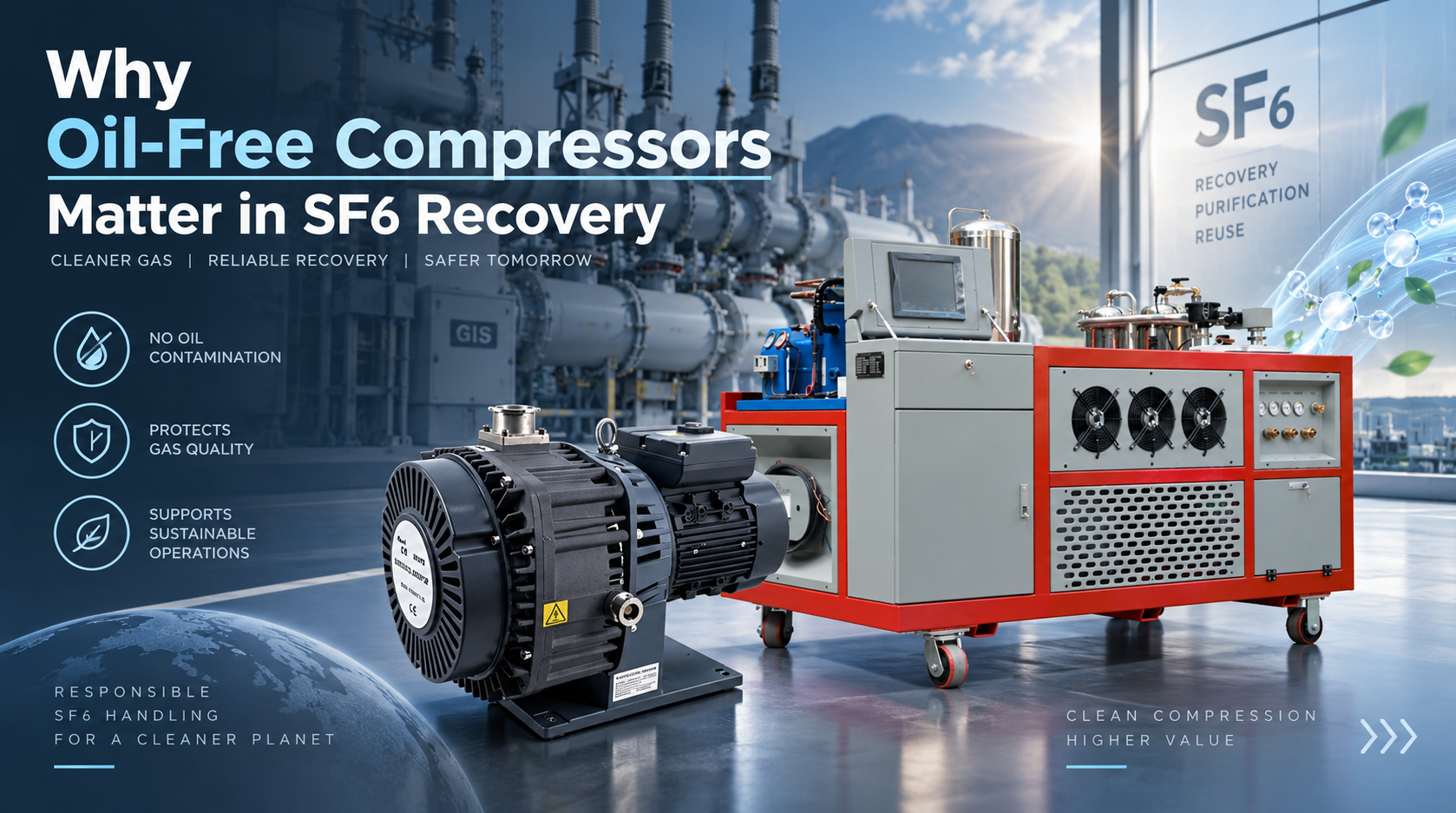
The compressor is one of the main components in SF6 recovery equipment. During recovery, it removes SF6 from the gas compartment, compresses the recovered SF6, and transfers it to the storage system.
Because the compressor comes into direct contact with SF6, compressor design affects both recovery performance and contamination control. Oil-free compressors help reduce the risk of introducing oil contamination into the SF6 gas circuit. This becomes especially important when recovered SF6 will undergo SF6 purification, gas analysis, and possible reuse.
The purpose is simple:
Recover SF6 without introducing unnecessary oil contamination.
What Is the Role of the Recovery Compressor?
During maintenance, the main recovery compressor transfers SF6 from GIS, circuit breakers, or other gas-filled electrical equipment to the storage system.
A typical recovery path is:
Gas Compartment → Main Recovery Compressor → Storage System
The main recovery compressor performs two basic functions:
- removes SF6 from the gas compartment;
- compresses recovered SF6 for transfer and storage.
As the source-side pressure decreases, low-pressure recovery may require a vacuum compressor. The two compressors serve different purposes:
Main recovery compressor → main SF6 recovery
Vacuum compressor → low-pressure SF6 recovery
This distinction is important when comparing SF6 recovery equipment. Compressor type and compressor capacity describe different parts of system performance.
Oil-Lubricated vs Oil-Free Compressors: What Is the Difference?
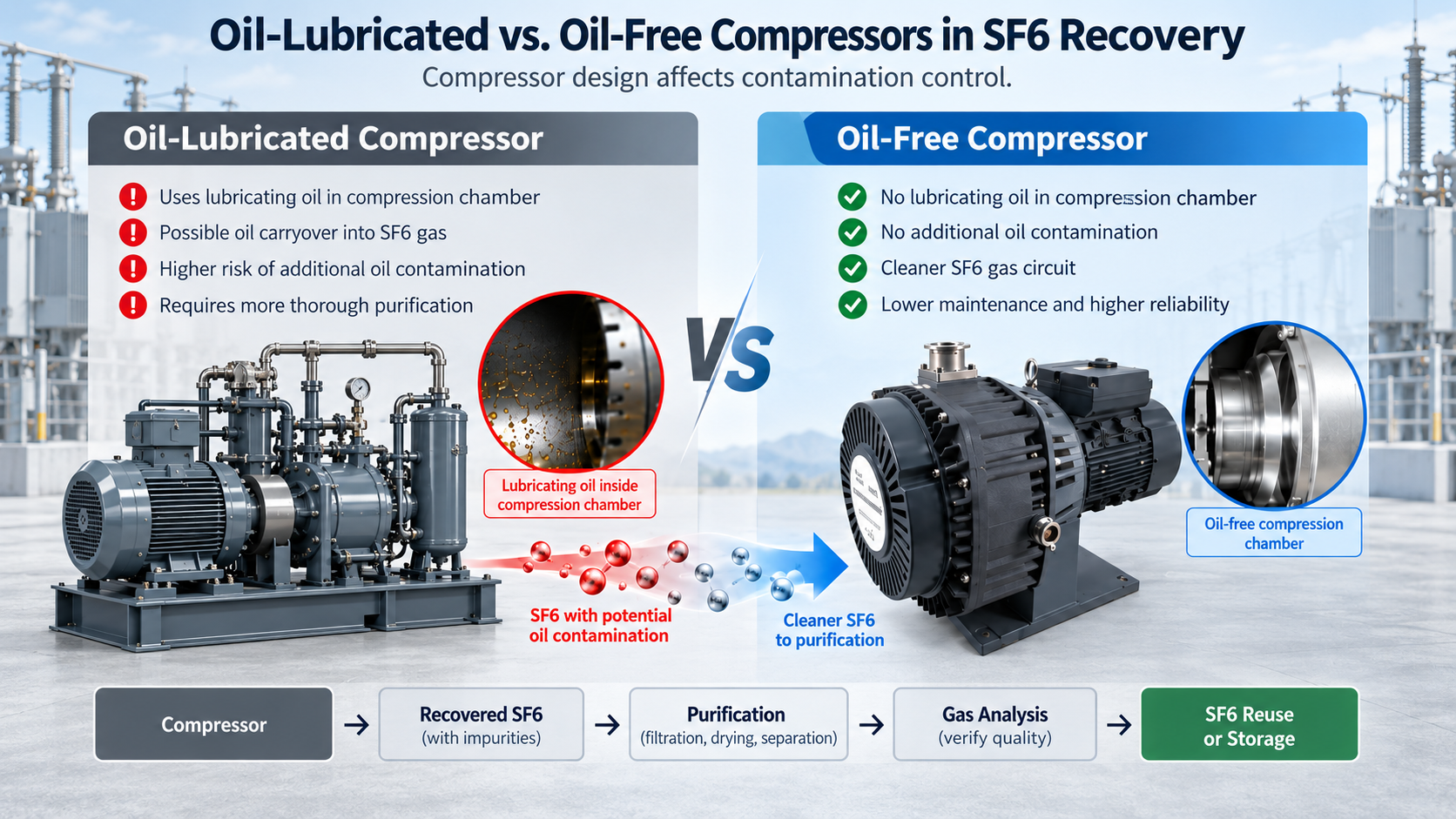
A conventional oil-lubricated compressor uses lubricant for functions such as lubrication, sealing, or cooling. This design works well in many industrial applications.
SF6 recovery equipment requires stricter contamination control.
Recovered SF6 may later undergo SF6 purification, gas analysis, and reuse. The recovery process should therefore avoid introducing additional contaminants into the SF6 gas circuit.
Oil-free compressors reduce the risk of lubricant entering the SF6 gas circuit during compression.
The main difference is not simply compressor efficiency.
The main difference is contamination control.
For SF6 gas handling, the recovery process should avoid adding contaminants that make later purification more difficult.
How Oil Contamination Affects SF6 Recovery and Purification
Recovered SF6 may already contain contaminants before it enters the recovery equipment.
Depending on equipment condition and maintenance history, recovered SF6 may contain:
- moisture;
- solid particles;
- mineral oil;
- air;
- CF4;
- decomposition by-products.
Your existing SF6 purification data identifies mineral oil as one of the contaminants that may require adsorption during the purification process.
The recovery equipment should not introduce additional oil contamination during compression.
Additional Oil Contamination Increases Purification Requirements
Different contaminants require different purification processes.
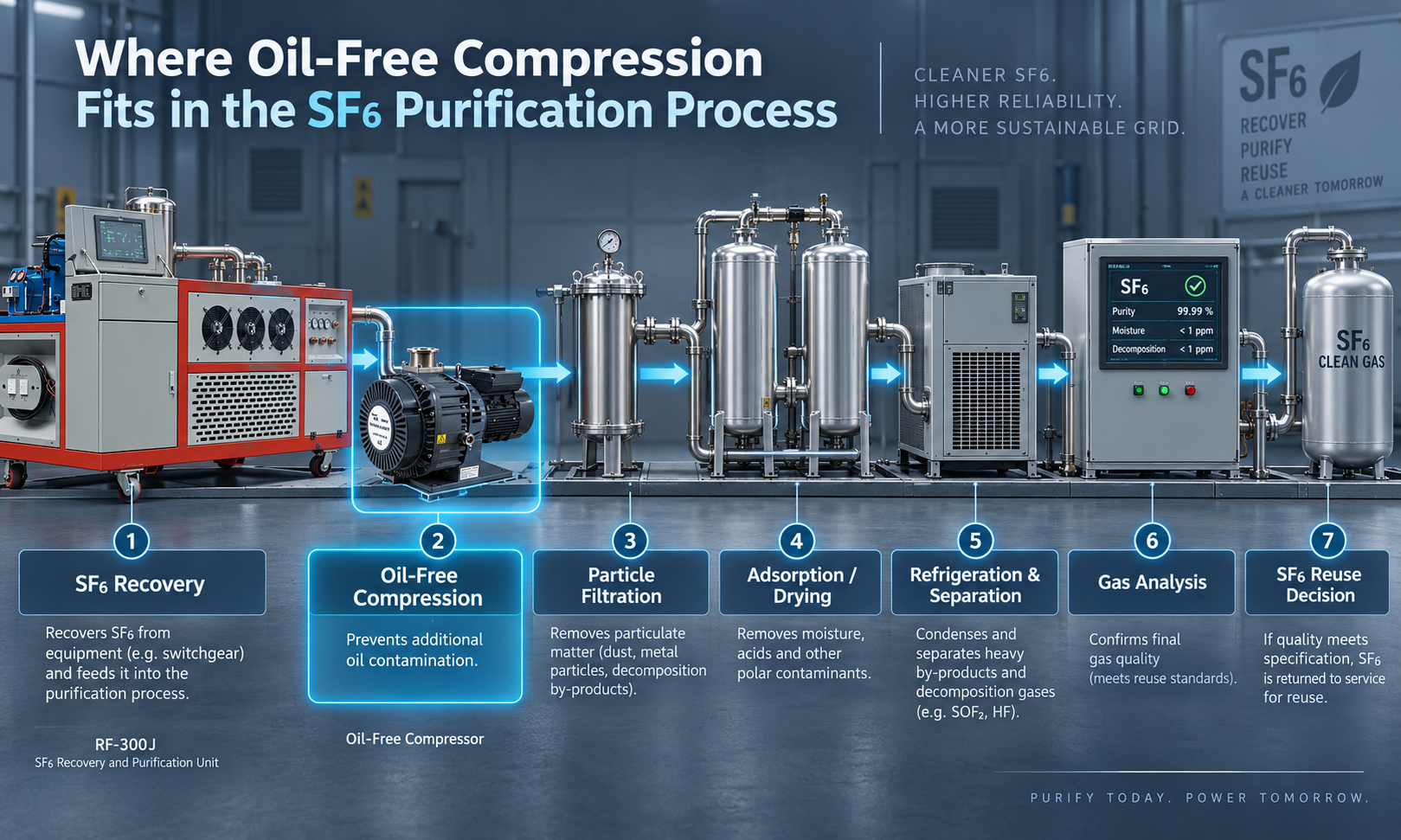
A typical SF6 purification process may include:
Recovery → Particle Filtration → Adsorption → Circulating Purification → Refrigeration and Separation → Gas Analysis → SF6 Reuse
Your existing process data places the oil-free compressor and pre-filter system in the recovery and pre-filtration stage. Molecular-sieve adsorption then targets moisture, mineral oil, and selected decomposition by-products.
If the compressor introduces additional oil contamination, the SF6 purification system has more contamination to remove.
Using an oil-free compressor helps prevent this additional purification requirement.
Oil Contamination Complicates Gas Quality Control
SF6 recovery is often only the first step.
Operators may need to purify recovered SF6 and determine whether the final gas quality is suitable for reuse.
The recovery process should therefore protect recovered SF6 from unnecessary contamination before SF6 purification begins.
An oil-free SF6 recovery compressor helps reduce one potential source of oil contamination in the SF6 gas circuit.
How an Oil-Free SF6 Recovery Compressor Protects the SF6 Gas Circuit
The main technical value of an oil-free SF6 recovery compressor is contamination control.
Reduces the Risk of Additional Oil Contamination
The compressor handles recovered SF6 without intentionally introducing lubricant into the compression path.
This reduces the risk of adding oil contamination during recovery.
For operators who plan to purify and reuse recovered SF6, controlling contamination at the recovery stage makes the later purification process easier to manage.
Helps Keep the SF6 Gas Circuit Clean
Recovered SF6 passes through more than the compressor.
The SF6 gas circuit may also include:
- hoses;
- valves;
- filters;
- piping;
- storage tanks;
- purification components.
Reducing oil contamination at the compression stage helps limit unnecessary contamination throughout the SF6 gas circuit.
Works as Part of the SF6 Purification System
An oil-free SF6 recovery compressor does not purify SF6 by itself.
It works as one part of the complete SF6 purification system.
Depending on the gas condition and equipment configuration, the SF6 purification process may include:
particle filtration + adsorption + drying + heat exchange + refrigeration + separation
For example, the RF-300J combines recovery, particle filtration, compression, heat exchange, low-temperature liquefaction, storage, and circulating purification in one system.
Each component performs a specific function in the SF6 purification process.
Why Oil-Free Compression Cannot Replace SF6 Purification
This distinction is important.
An oil-free compressor helps prevent additional oil contamination, but it does not automatically make recovered SF6 suitable for reuse.
Recovered SF6 may still contain:
- moisture;
- particles;
- existing oil contamination;
- air;
- CF4;
- decomposition by-products.
The recovered SF6 may therefore require filtration, adsorption, drying, separation, and other SF6 purification processes.
After purification, operators still need gas analysis to determine the final gas quality.
The RF-300J provides a useful example:
| Gas-Quality Parameter | RF-300J Specification |
|---|---|
| SF6 Purity | ≥99.9% |
| Moisture | ≤40 ppmv |
| Air Content | ≤0.03% |
| CF4 Content | ≤0.01% |
| Particle Filtration | <1 μm |
These values describe the performance of the complete RF-300J SF6 purification system. They do not describe the performance of the oil-free compressor alone.
The relationship is:
Oil-Free Compression → Reduced Oil Contamination Risk → SF6 Purification → Gas Analysis → SF6 Reuse Decision
Completing the SF6 purification process does not automatically confirm that recovered SF6 is suitable for reuse. Operators must verify the final gas quality through gas analysis and compare the results with the applicable project requirements.
Oil-Free Compression in RF SF6 Recovery Equipment
RF equipment provides practical examples of how oil-free compressors work with recovery, vacuum, filtration, purification, and storage components.
RF-300J: Oil-Free Compression in an Integrated Recovery and Purification System
The RF-300J SF6 Recovery and Purification Unit uses an oil-free SF6 recovery compressor as part of an integrated recovery and purification system.
Key specifications include:
| Parameter | RF-300J |
|---|---|
| SF6 Recovery Speed | 150 kg/h |
| Main Recovery Compressor Capacity | 38 m³/h |
| Vacuum Compressor Capacity | 31.3 m³/h |
| Vacuum Pump Capacity | Up to 64 m³/h |
| Particle Filtration | <1 μm |
| SF6 Purity After Purification | ≥99.9% |
The RF-300J combines oil-free compression with filtration, purification, vacuum, storage, and refilling functions.
These specifications describe different functions.
38 m³/h describes the main recovery compressor capacity.
31.3 m³/h describes the vacuum compressor capacity.
Oil-free compression describes the compressor design used to reduce the risk of oil contamination.
These parameters should not be treated as the same specification.
RF-391: Oil-Free Compressor Specifications
The RF-391 also uses an oil-free SF6 recovery compressor.
Available equipment data includes:
| Parameter | RF-391 |
|---|---|
| Oil-Free Compressor | 30 m³/h |
| Compressor Output Pressure | 50 bar |
| Vacuum Compressor | 31.3 m³/h |
| Particle Filtration | <1 μm |
| Storage Tank | 300 L |
The RF-391 data identifies a 30 m³/h oil-free compressor with a 50 bar output pressure.
These specifications answer different engineering questions.
Compressor capacity answers:
How much gas can the compressor move?
Oil-free compression answers:
How does the compressor design help control oil contamination?
Both matter when selecting SF6 recovery equipment.
What to Check When Selecting an SF6 Recovery Compressor
Do not compare SF6 recovery equipment by compressor flow rate alone.
Engineers should also check:
- whether the main recovery compressor uses oil-free compression;
- main recovery compressor capacity;
- vacuum compressor capacity;
- low-pressure SF6 recovery capability;
- filtration precision;
- SF6 purification functions;
- storage system configuration;
- gas analysis requirements.
Higher compressor capacity may increase gas-transfer capacity. However, compressor capacity does not describe contamination control.
The difference is simple:
Compressor capacity describes gas-transfer capacity.
Oil-free compression describes a compressor design that helps control oil contamination.
For applications where recovered SF6 will undergo purification and possible reuse, both factors matter.
Clean Compression Is the First Step, Not the Final Step
Oil-free compressors help reduce the risk of introducing unnecessary oil contamination during SF6 recovery.
However, oil-free compression is only the first step in contamination control.
Recovered SF6 may still contain moisture, particles, existing oil contamination, air, CF4, and decomposition by-products. The gas may therefore still require:
Filtration → Adsorption → Drying → Separation → SF6 Purification → Gas Analysis
Only after gas analysis can operators determine whether the final gas quality is suitable for reuse.
When selecting SF6 recovery equipment, engineers should ask two basic questions:
Can the equipment recover SF6 efficiently?
Can the equipment recover SF6 without introducing unnecessary oil contamination?
A properly configured SF6 recovery system should address both.
For help evaluating main recovery compressor capacity, vacuum compressor capacity, low-pressure SF6 recovery, filtration, or SF6 purification requirements for a specific project, contact our engineering team at [email protected].
FAQ
Why are oil-free compressors used in SF6 recovery?
Oil-free compressors help reduce the risk of introducing additional oil contamination into recovered SF6 and the SF6 gas circuit.
Do oil-free compressors increase SF6 purity?
Not by themselves. They help prevent additional oil contamination, but they do not remove moisture, particles, air, CF4, existing oil contamination, or decomposition by-products.
Do oil-free compressors replace the SF6 purification system?
No. The compressor performs SF6 recovery and compression. The SF6 purification system performs filtration, adsorption, drying, separation, and other purification functions.
What should buyers check when selecting an SF6 recovery compressor?
Check the main recovery compressor capacity, vacuum compressor capacity, low-pressure SF6 recovery capability, filtration system, SF6 purification functions, storage system, and gas analysis requirements.