Why Does SF6 Recovery Speed Drop at Low Pressure?
An SF6 recovery unit does not maintain the same recovery speed throughout the entire recovery process.
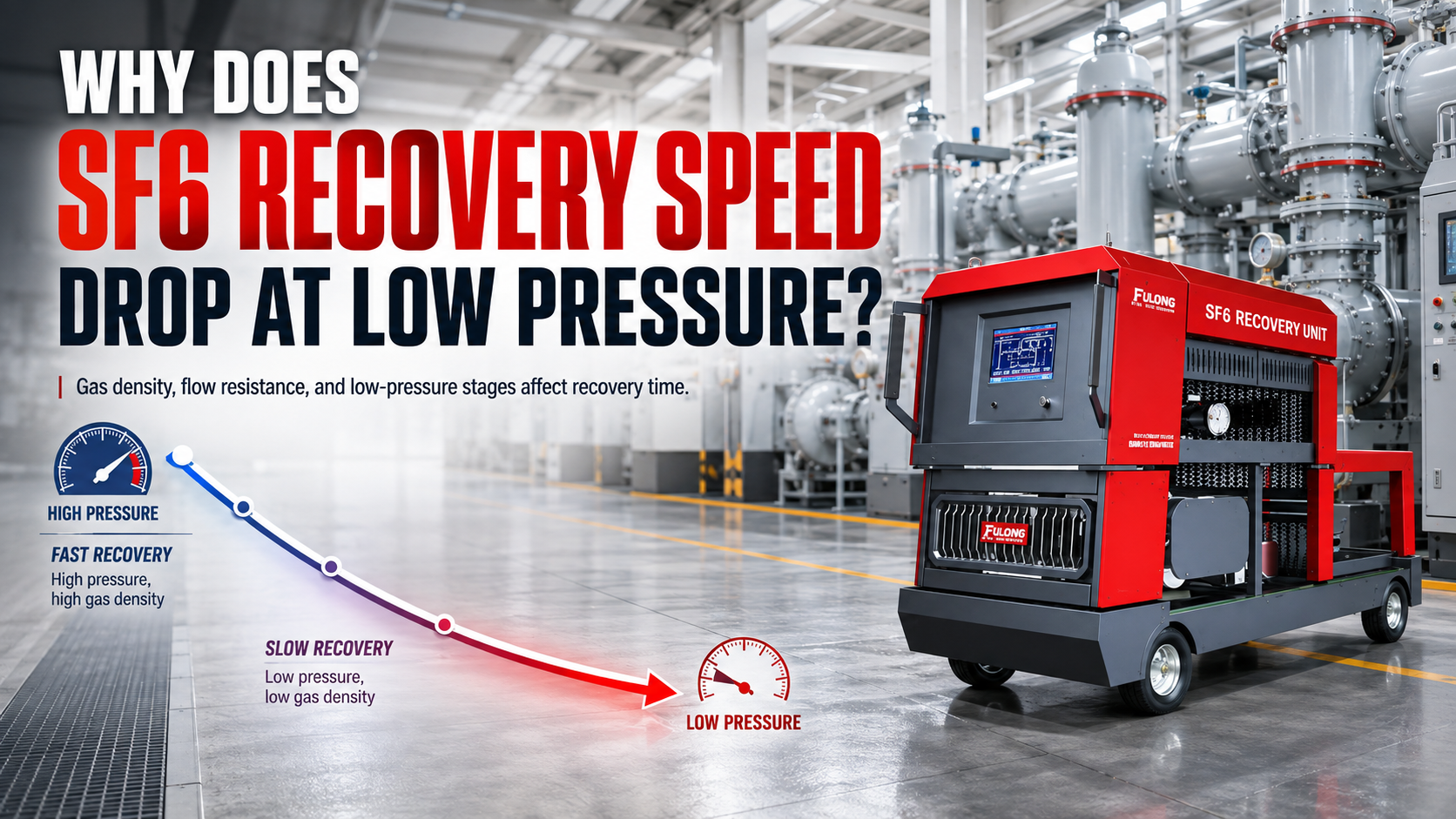
At the beginning of SF6 gas recovery, the gas compartment has higher pressure and higher gas density. As recovery continues, the source-side pressure falls. Gas density decreases, compressor operating conditions change, and flow resistance has a greater effect.
As a result, SF6 recovery speed normally drops during the low-pressure stage.
This change is part of the normal recovery process. Therefore, engineers should not treat a rated recovery speed in kg/h as a constant value from the initial pressure to the final recovery pressure.
SF6 Recovery Speed Changes With Pressure
During the main recovery stage, the compressor transfers SF6 from the GIS gas compartment to the storage system.
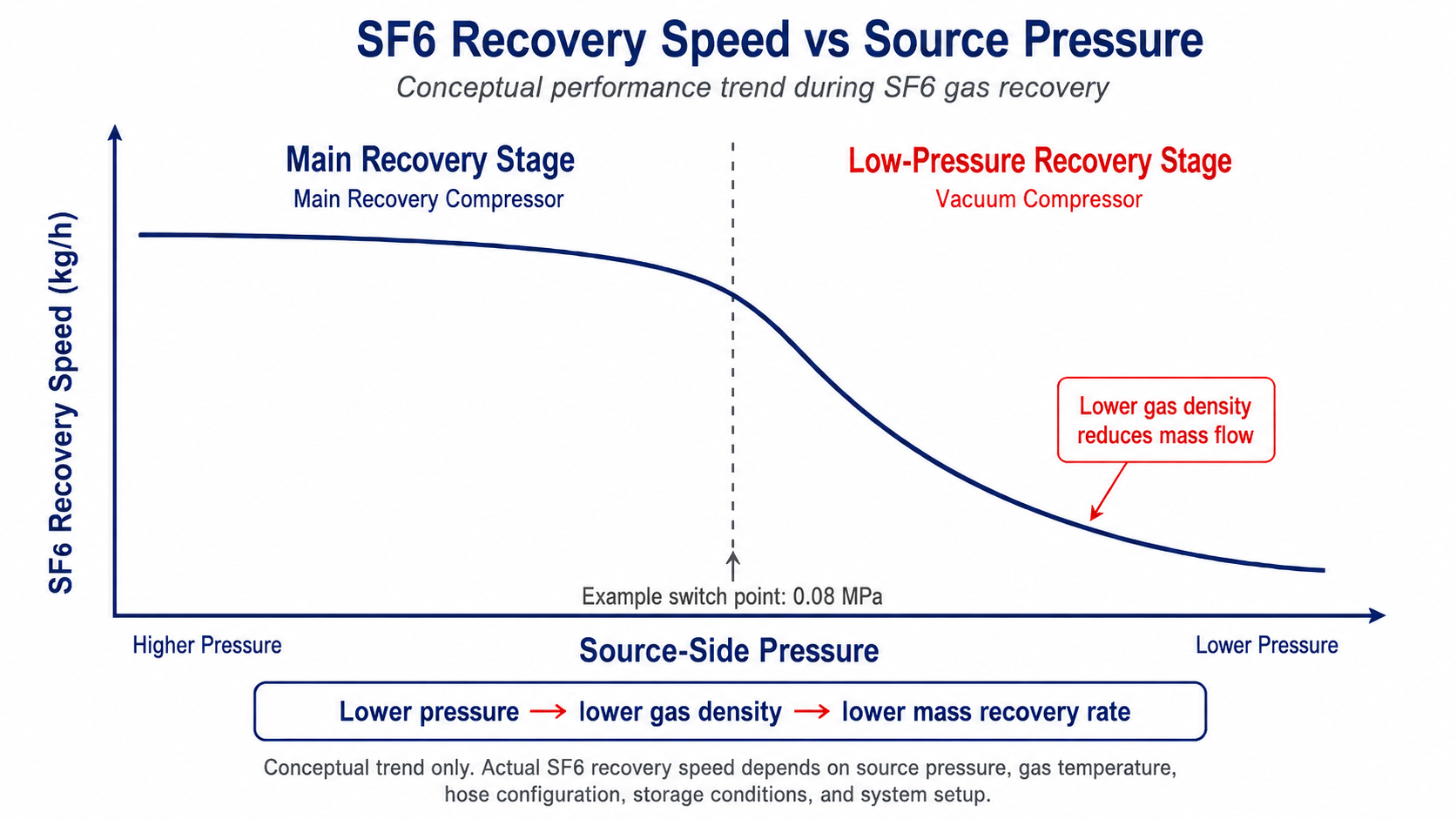
At higher source pressure, each unit of gas volume contains more SF6 mass. However, as the pressure falls, gas density also decreases. The same intake volume then contains less SF6 mass.
In simple terms:
Lower pressure → lower gas density → lower mass recovery rate
Therefore, an SF6 recovery unit can continue moving gas while its mass recovery rate in kg/h decreases.
The technical material provided for this article also identifies lower gas density as a key reason for reduced mass flow during low-pressure SF6 recovery.
Why Does SF6 Recovery Slow Down at Low Pressure?
Several factors affect SF6 recovery speed as source pressure decreases.
Lower Gas Density Reduces Mass Flow
At higher pressure, the compressor receives more SF6 mass during each intake cycle.
As gas-compartment pressure decreases, however, the gas becomes less dense. Each cubic meter then contains less SF6 mass.
Therefore, even when volumetric flow remains relatively stable, the actual mass flow in kg/h decreases.
This is why a rated SF6 recovery speed should not be interpreted as a constant recovery rate throughout the complete recovery cycle.
Lower Suction Pressure Changes Compressor Performance
As source-side pressure falls, the compressor receives gas at a lower suction pressure.
At the same time, the system must continue transferring recovered SF6 toward the storage system. These conditions make the low-pressure stage more demanding.
Consequently, the final part of the recovery process normally takes longer than the initial stage.
For equipment evaluation, maximum recovery speed alone does not describe total SF6 recovery performance.
Flow Resistance Becomes More Important
Hoses, filters, valves, fittings, and self-sealing couplings all create resistance to gas flow.
During the higher-pressure stage, these losses may have a limited effect on SF6 recovery speed. However, as source pressure falls, the same restriction can have a much greater effect on gas flow.
For example, a restricted hose, blocked filter, or contaminated coupling can significantly increase SF6 recovery time.
The troubleshooting information in the supplied material identifies intake-line restrictions, hose connections, and dirty or blocked self-sealing valves as possible causes of slow recovery.
Therefore, operators should check the complete gas path instead of evaluating the recovery unit alone.
Hose Size and Length Affect SF6 Recovery Time
The hose between the GIS gas compartment and the SF6 recovery unit forms part of the recovery circuit.
A smaller hose diameter increases flow resistance. Likewise, a longer hose can increase pressure loss.
These effects become more important when source pressure is low.
For this reason, engineers should consider hose diameter, hose length, filters, valves, couplings, and gas-compartment connections when evaluating SF6 recovery performance.
A high-capacity compressor cannot fully compensate for a heavily restricted gas path.
What Happens During Low-Pressure SF6 Recovery?
When source pressure becomes too low for efficient main recovery, the recovery system changes operating mode.
At this stage, a vacuum compressor continues low-pressure SF6 recovery.
The main components perform different functions:
- Main recovery compressor: transfers most of the SF6 during the main recovery stage.
- Vacuum compressor: continues SF6 recovery at low source pressure.
- Vacuum pump: evacuates air and moisture from hoses, gas circuits, or empty gas compartments.
The vacuum compressor and vacuum pump should not be confused.
Low-pressure SF6 recovery remains part of the gas recovery process. Vacuum evacuation serves a different purpose.
The supplied operating material shows that the recovery system starts the vacuum compressor after source pressure enters the low-pressure range so that residual SF6 can continue moving through the recovery circuit.
Why Does the Final Recovery Stage Take Longer?
The first part of SF6 recovery usually proceeds faster because the gas compartment has higher pressure and higher gas density.
Later, source pressure decreases. Gas density falls, mass flow drops, and flow resistance becomes more significant. At the same time, the recovery system enters its low-pressure operating stage.
Therefore, the remaining SF6 takes more time to remove.
This does not mean that the final stage contains more gas. Instead, the remaining gas becomes more difficult to transfer under low-pressure conditions.
Does a Larger Compressor Always Mean Faster SF6 Recovery?
Not necessarily.
A larger main compressor can improve performance during the main recovery stage. However, total SF6 recovery time also depends on low-pressure recovery performance.
Engineers should consider the rated SF6 recovery speed, main compressor capacity, vacuum compressor capacity, initial source pressure, final recovery pressure, hose configuration, gas temperature, storage conditions, and required recovery endpoint.
Therefore, comparing SF6 recovery equipment only by the maximum kg/h value can give an incomplete picture of actual field performance.
RF-300J Example: Rated Recovery Speed and Low-Pressure Recovery
The RF-300J provides a useful example of why several specifications should be evaluated together.
| Parameter | RF-300J |
|---|---|
| SF6 Recovery Speed | 150 kg/h |
| Main Compressor Capacity | 38 m³/h |
| Vacuum Compressor Capacity | 31.3 m³/h |
| Vacuum Pump Capacity | Up to 64 m³/h |
| Low-Pressure Recovery Switch Point | 0.08 MPa |
| Low-Pressure Recovery Endpoint | 10 kPa / 0.01 MPa |
| Ultimate Vacuum | ≤10 Pa |
| Storage Tank | 300 L |
The RF-300J technical data specifies an SF6 recovery speed of 150 kg/h, a 38 m³/h main compressor, a 31.3 m³/h vacuum compressor, and a vacuum pump capacity of up to 64 m³/h. The stated ultimate vacuum is ≤10 Pa, and the storage tank capacity is 300 L.
The operating information also shows that the system changes to low-pressure recovery at 0.08 MPa and reaches the stated low-pressure recovery endpoint at 10 kPa (0.01 MPa).
These values describe different operating functions.
The 150 kg/h value represents rated SF6 recovery capacity. In contrast, compressor values in m³/h describe volumetric capacity.
Therefore, 150 kg/h does not mean that the RF-300J continuously recovers SF6 at exactly 150 kg/h from the beginning of the recovery process to the 10 kPa endpoint.
Actual SF6 recovery speed changes as source pressure decreases.
Vacuum Pump Capacity Is Not SF6 Recovery Speed
Vacuum pump capacity and SF6 recovery speed describe different functions.
The vacuum compressor supports low-pressure SF6 recovery. By contrast, the vacuum pump evacuates air and moisture from hoses, gas circuits, and empty gas compartments.
Therefore:
SF6 recovery speed describes SF6 gas-transfer performance.
Vacuum compressor capacity relates to low-pressure SF6 recovery.
Vacuum pump capacity relates to vacuum evacuation.
A larger vacuum pump does not automatically mean a higher SF6 recovery rate.
What Should Buyers Ask About SF6 Recovery Performance?
Instead of asking only, “What is the SF6 recovery speed?”, buyers should also ask:
- Under what conditions is the rated recovery speed measured?
- What is the final recovery pressure?
- Does the unit include a vacuum compressor?
- At what pressure does low-pressure recovery start?
- What is the vacuum compressor capacity?
- What hose configuration does the system require?
- How does recovery performance change as source pressure decreases?
These questions provide a more complete view of SF6 recovery unit performance.
What Can Cause Abnormally Slow SF6 Recovery?
A lower SF6 recovery rate during the low-pressure stage is normal. However, an unusually slow recovery process may indicate a restriction or equipment problem.
Operators should check filters, hoses, self-sealing couplings, valves, hose connections, and vacuum-compressor operation.
The supplied troubleshooting information also identifies blocked intake piping and restricted hose or coupling connections as common causes of slow SF6 recovery.
The key is to distinguish normal low-pressure performance from abnormal flow restriction or equipment malfunction.
FAQ
Why does SF6 recovery speed decrease at low pressure?
As source pressure falls, SF6 density decreases. Therefore, each unit of intake volume contains less gas mass. Flow resistance and compressor operating conditions also have a greater effect during the low-pressure stage.
Is rated SF6 recovery speed constant?
No. Actual SF6 recovery speed changes with source pressure, gas density, hose configuration, storage conditions, gas temperature, and the operating stage of the recovery unit.
What does the vacuum compressor do?
The vacuum compressor continues low-pressure SF6 recovery after the main recovery stage becomes less effective.
Does the vacuum pump recover SF6?
The vacuum pump mainly evacuates air and moisture from hoses, gas circuits, and empty gas compartments. It performs a different function from the vacuum compressor.
Does a larger compressor always reduce SF6 recovery time?
No. Total recovery time also depends on low-pressure recovery performance, hose configuration, final recovery pressure, gas conditions, and the required recovery endpoint.
Understanding the Full SF6 Recovery Cycle
Rated SF6 recovery speed is an important specification, but it does not describe the complete recovery cycle.
As source pressure decreases, SF6 density falls and flow resistance becomes more important. The recovery system then moves from the main recovery stage to low-pressure recovery.
Therefore, the more useful engineering question is not simply:
“How many kilograms per hour can the unit recover?”
Instead, engineers should ask:
“How does the SF6 recovery unit perform from the initial pressure to the required recovery endpoint?”
This approach provides a better basis for comparing SF6 recovery equipment and estimating GIS maintenance time.
For projects where gas quantity, recovery time, final recovery pressure, hose configuration, or storage requirements need further review, technical information can be exchanged with our engineering team at [email protected]. This allows the discussion to focus on the actual SF6 recovery task rather than a single nominal specification.