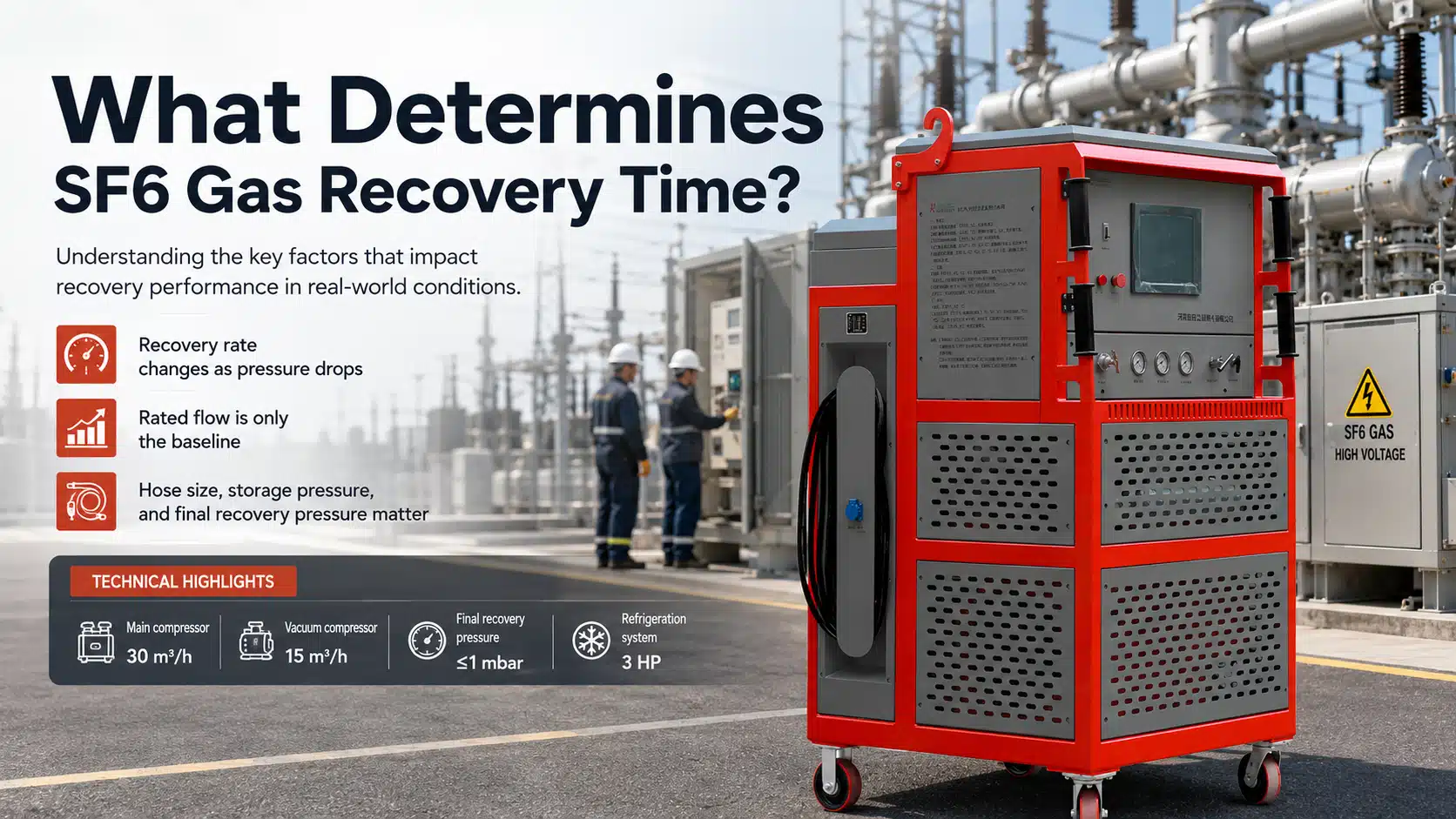
For GIS maintenance teams, SF6 gas recovery time affects outage planning,labor hours, and field efficiency. A recovery unit may have a rated compressor flow of 15 or 30 m³/h. However, that figure alone cannot predict how long a recovery job will take.
More importantly,the SF6 recovery rate changes throughout the job,which directly affects SF6 gas recovery time.
At the start, the gas compartment remains under positive pressure and SF6 density is relatively high. As recovery continues, pressure and gas density fall. Eventually, the system enters negative-pressure recovery, where the vacuum compressor removes the remaining gas. Meanwhile, hoses, storage pressure, cooling, and other system conditions can restrict the actual flow.Therefore, SF6 gas recovery time depends on the effective recovery rate across the full pressure range, not on one rated flow value.
Recovery Capacity Sets the Baseline
First,the main compressor sets the basic transfer capacity of SF6 gas recovery equipment and directly influences SF6 gas recovery time during positive-pressure recovery.
Typical RF-series specifications include:
| Model | Main Compressor Capacity |
|---|---|
| RF-051 | 15 m³/h |
| RF-151 | 15 m³/h |
| RF-391 | 30 m³/h |
| RF-300J | 38 m³/h |
Under similar operating conditions, a higher compressor capacity can shorten recovery time. However, engineers should not treat the rated flow as a constant field recovery rate.As inlet pressure falls, the compressor receives less SF6 mass per unit time. At the same time, pressure on the storage side may rise. Consequently, compressor performance changes during the recovery process.
The first principle is therefore simple:Rated compressor flow ≠ constant SF6 recovery rate.A 30 m³/h compressor does not necessarily complete every recovery job twice as fast as a 15 m³/h compressor.
Pressure Drop Slows the SF6 Recovery Rate
Pressure is one of the main factors that determines SF6 recovery rate.
A typical recovery process moves through several pressure conditions:
Positive pressure → atmospheric pressure → negative pressure → final recovery pressure
At first, SF6 is relatively dense. Therefore, the main compressor can transfer a comparatively large mass of gas.As the compartment empties, however, absolute pressure falls. Gas density falls with it. Consequently, the amount of SF6 entering the recovery equipment per unit time also decreases.
The relationship is straightforward:
Lower pressure
→ lower gas density
→ lower effective mass flow
→ slower recovery
This is why SF6 recovery does not behave like a constant-flow pumping process.
Final Recovery Pressure Changes the Job Time
The target final pressure also has a direct effect on SF6 gas recovery time.
Stopping at 50 mbar is different from continuing to 5 mbar or 1 mbar. A lower target leaves less residual SF6 in the gas compartment. However, the last portion of gas becomes increasingly difficult to remove.The supplied RF-series specifications show final recovery pressures of ≤1 mbar for the RF-051 and RF-391, while the RF-300J reaches <1 mbar under specified operating conditions.Therefore:
Lower final recovery pressure → less residual SF6 → longer low-pressure recovery
For a meaningful comparison, engineers should always compare SF6 gas recovery time at the same final recovery pressure.
Two Compressors Handle Different Recovery Stages
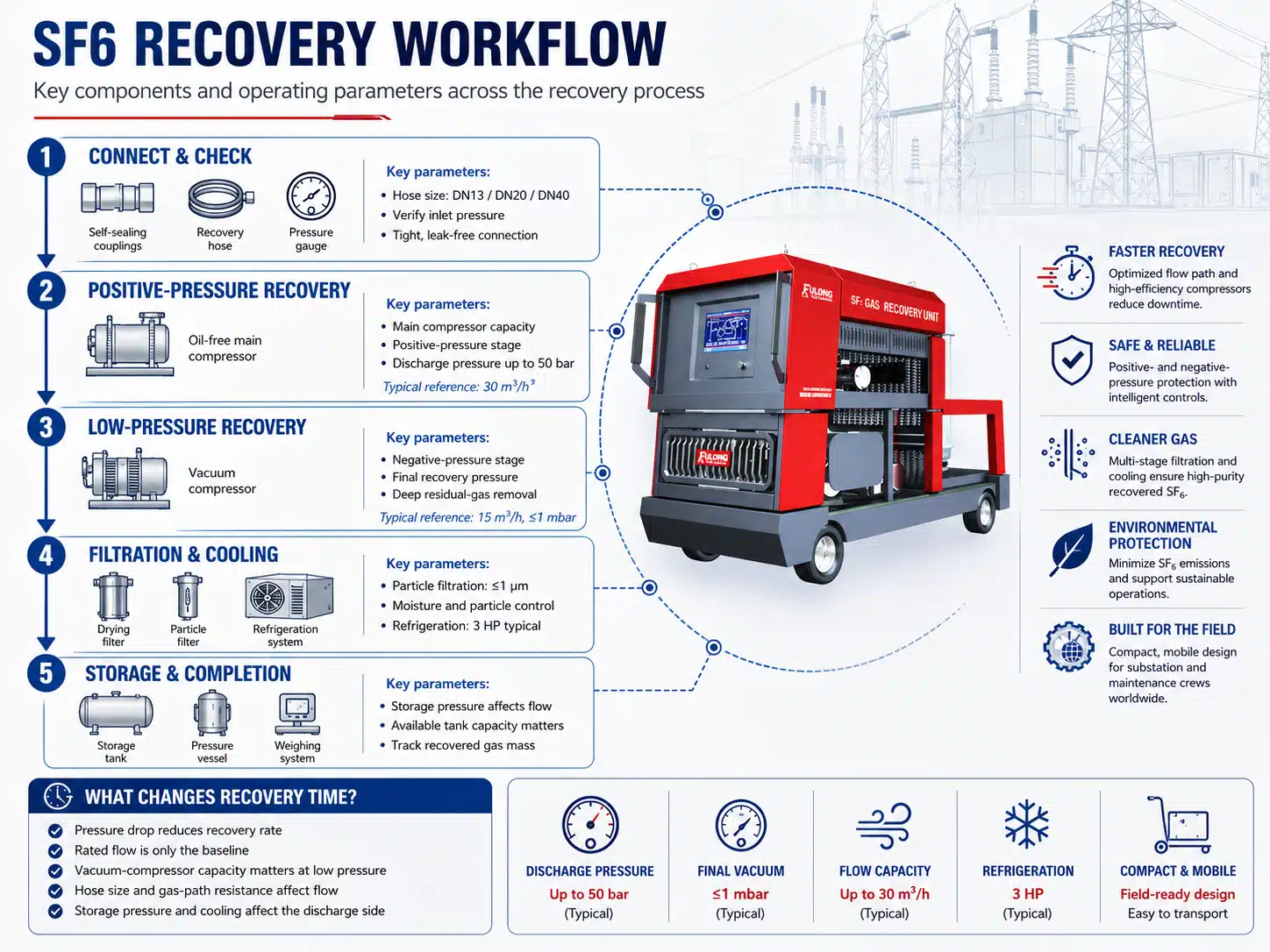
An integrated SF6 recovery unit uses the main compressor and vacuum compressor for different pressure ranges.
First, the oil-free main compressor handles most of the positive-pressure gas transfer.Then, as compartment pressure approaches atmospheric pressure, the SF6 vacuum compressor becomes increasingly important.The recovery path can be represented as:
Gas compartment → vacuum compressor → main compressor → cooling → storage
The vacuum compressor draws SF6 from the low-pressure inlet side. Meanwhile, the main compressor maintains the discharge pressure required to transfer the recovered gas into storage.
Typical RF-series figures include:
| Model | Main Compressor | Vacuum Compressor | Final Recovery Pressure |
|---|---|---|---|
| RF-051 | 15 m³/h | 7.2 m³/h | ≤1 mbar |
| RF-391 | 30 m³/h | 15 m³/h | ≤1 mbar |
| RF-300J | 38 m³/h | 30 m³/h | <1 mbar |
As a result, the main compressor rating alone cannot define total SF6 gas recovery time.A large main compressor may shorten the early stage. However, if low-pressure recovery capacity is limited, the final stage can still become the bottleneck.
SF6 Quantity Defines the Recovery Load
In practice,the recovery equipment removes a quantity of SF6, not simply an empty compartment volume.
Therefore, GIS volume is only one part of the recovery load.
The amount of gas also depends on:
- initial absolute pressure
- gas temperature
- SF6 density
Under comparable conditions, a larger gas compartment contains more SF6. Likewise, a higher initial pressure generally means more gas must be transferred from the same volume.Consequently, two GIS compartments of similar size can require different SF6 gas recovery times.For a practical estimate, technicians should first establish the gas compartment volume, initial absolute pressure, gas temperature, and target final recovery pressure.
Hoses and Couplings Can Reduce the SF6 Recovery Rate
A high-capacity compressor cannot maintain its expected field performance if the gas path restricts flow.
Before SF6 reaches the compressor, it may pass through:
Gas compartment → coupling → hose → valve → filter → compressor
Every restriction creates pressure loss.
Therefore, the following factors can affect the actual SF6 recovery rate:
- hose diameter
- hose length
- coupling size
- valve opening
- bends and fittings
- filter condition
The supplied RF configurations include DN13 recovery hoses, DN20 hoses for larger equipment, and DN20 or DN40 self-sealing couplings.
Restrictions Matter More at Low Pressure
During early positive-pressure recovery, a moderate restriction may have a limited effect.However, the same restriction becomes more important as inlet pressure falls.For example, a high-flow vacuum compressor connected through a long or narrow hose may receive less SF6 than its rated capacity suggests.
As a result:A larger compressor cannot increase the recovery rate if the upstream gas path cannot supply enough flow.Therefore, hose and coupling size are part of the recovery system performance, not merely connection details.
How Storage Pressure Affects SF6 Gas Recovery Time
SF6 recovery has two changing pressure conditions.On the inlet side, GIS pressure falls.Meanwhile, on the discharge side, recovered SF6 enters a storage tank or cylinder.
As the storage vessel fills, its pressure may rise. Consequently, the compressor has to work against a higher discharge pressure.This can affect the actual transfer rate.
Storage capacity also matters. RF-series equipment uses different tank sizes according to the expected gas volume.If available storage is insufficient, technicians may need to stop recovery, change cylinders, or transfer gas. Therefore, total field time can increase even when the compressor capacity remains unchanged.
Cooling Supports Stable SF6 Recovery
Compression raises SF6 temperature.
Therefore, larger recovery systems use cooling to control storage-side conditions.Under suitable pressure and temperature conditions, cooling supports SF6 condensation. As a result, the system can store the recovered gas at higher density and use the available tank volume more efficiently.
The supplied configurations include:
- RF-391: 3 HP refrigeration system
- RF-300J: 5 HP refrigeration system
Importantly, the compressor does not liquefy SF6 by itself.
Instead:Compression raises pressure,while,cooling removes heat.Together, they create more favorable storage conditions.
For this reason, cooling can indirectly affect SF6 gas recovery time, particularly during high-volume recovery.
Filter Condition Can Reduce the Recovery Rate
Recovered SF6 may carry moisture, particles, or decomposition products. Therefore, filtration protects both the gas and downstream equipment.The supplied RF-series specifications include particle filtration to ≤1 μm.Under normal conditions, filtration should not determine total recovery time.However, a heavily loaded filter adds resistance to the gas path. Consequently, less gas may reach the compressor.Filter condition is therefore a secondary factor, but it is worth checking when a recovery unit performs below its expected rate.
RF-391: Why 30 m³/h Does Not Tell the Whole Story
The RF-391 shows why engineers should not use one flow rating to estimate SF6 gas recovery time.
Its supplied ratings include:
- Main compressor: 30 m³/h
- SF6 vacuum compressor: 15 m³/h
- Vacuum pump: 64 m³/h
- Final SF6 recovery pressure: ≤1 mbar
At first, the 30 m³/h main compressor handles most positive-pressure recovery.As pressure falls, however, gas density decreases and the effective mass recovery rate changes.
Next, the 15 m³/h vacuum compressor becomes increasingly important during negative-pressure recovery. At this stage, inlet pressure, hose resistance, storage conditions, and the final recovery target have a greater influence on recovery time.
The 64 m³/h vacuum pump performs a different task. It mainly evacuates air and residual moisture from the empty gas compartment before SF6 refilling.
Therefore:30 m³/h main compressor ≠ 15 m³/h vacuum compressor ≠ 64 m³/h vacuum pump
Each figure describes a different operating function.Consequently, none of these values should be used alone to calculate total SF6 recovery time.
Which Factors Matter Most?
For a practical estimate, engineers should focus on the variables that directly change gas quantity, pressure, or effective flow.
| Factor | Effect on SF6 Gas Recovery Time |
|---|---|
| SF6 quantity | More gas requires more transfer time |
| Initial pressure | Changes gas inventory and inlet conditions |
| Final recovery pressure | Deeper recovery usually takes longer |
| Main compressor capacity | Controls much of positive-pressure recovery |
| Vacuum compressor capacity | Controls low-pressure recovery |
| Hose and coupling size | Can restrict actual gas flow |
| Storage pressure | Changes compressor discharge conditions |
| Cooling performance | Supports stable storage conditions |
| Filter condition | Can add gas-path resistance |
No single factor works alone.Instead, the SF6 recovery rate changes continuously as the operating conditions change.
Why SF6 Recovery Time Depends on More Than Rated Flow
SF6 recovery starts under relatively favorable conditions. At this stage,the gas compartment remains pressurized, SF6 density is high, and the main compressor can transfer gas efficiently.
However, those conditions change throughout the job.As pressure falls, gas density decreases and the vacuum compressor takes on more of the recovery work. Meanwhile, hoses and couplings can restrict inlet flow. Storage pressure and cooling affect the discharge side. Finally, the target recovery pressure determines how long the low-pressure stage must continue.
Therefore, engineers should not estimate SF6 gas recovery time by simply dividing gas volume by a rated compressor flow.A more useful assessment considers the complete operating condition:
SF6 quantity → pressure profile → compressor capacity → vacuum compressor capacity → gas-path resistance → storage conditions → final recovery pressure
This complete system view matters more than any single flow rating.
In practice, every GIS service job presents a different combination of gas volume, pressure, connections, storage conditions, and recovery targets. If you are evaluating a recovery unit or estimating the recovery time for a specific project, you can share these operating parameters with us at [email protected]. We are always interested in comparing field conditions, recovery configurations, and practical ways to improve the SF6 recovery rate.