SF6 Recovery Pressure vs Ultimate Vacuum: What Is the Difference?
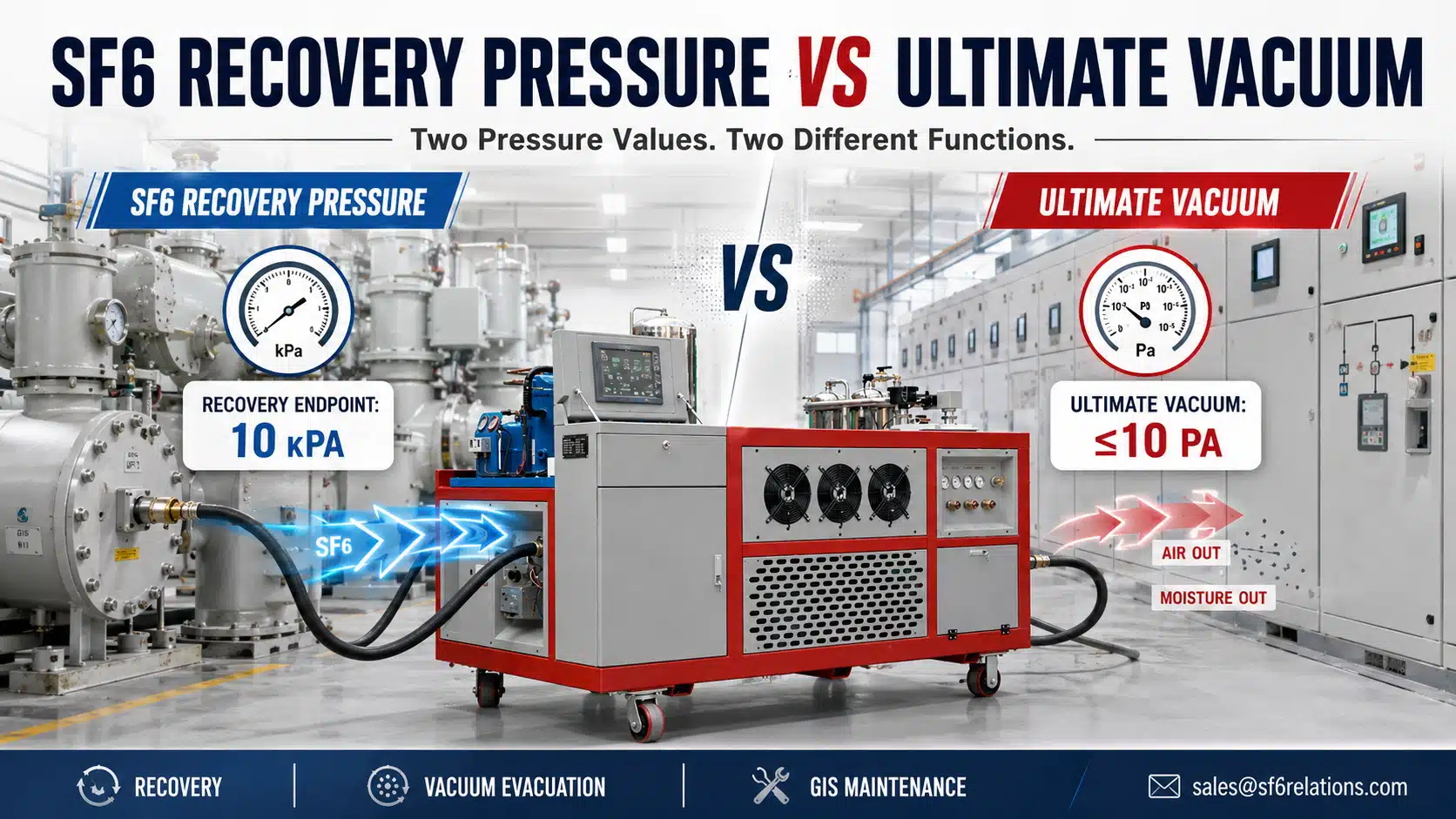
SF6 recovery pressure and ultimate vacuum are both pressure-related specifications, but they measure different functions within an SF6 gas handling system.
During gas recovery, recovery pressure describes the pressure on the gas-source side as an SF6 recovery unit removes gas from GIS or other gas-insulated equipment. Ultimate vacuum, by contrast, describes the lowest absolute pressure that the vacuum system can achieve while evacuating air and moisture from a hose, pipeline, or gas compartment.
The distinction matters because both values often appear on the same equipment data sheet. If engineers treat them as interchangeable, they can misread equipment capability, compare recovery units incorrectly, or specify the wrong requirement in an RFQ.
The key principle is simple: SF6 recovery pressure relates to gas removal. Ultimate vacuum relates to air evacuation.
What Is SF6 Recovery Pressure?
SF6 recovery pressure is the pressure measured on the inlet or gas-source side of an SF6 recovery unit during gas recovery.
In GIS maintenance, this value reflects the pressure inside the gas compartment as SF6 moves from the electrical equipment into a storage tank or cylinder.
At the start of recovery, the gas compartment normally remains under positive pressure. As the recovery unit removes SF6, the source-side pressure falls. The recovery system may then shift from the main compressor to a low-pressure recovery stage.
Therefore, SF6 recovery pressure changes throughout the process. It is not a fixed value.
Recovery Pressure vs Final Recovery Pressure
Recovery pressure and final recovery pressure are related, but they describe different stages of the recovery process.
During gas removal, recovery pressure changes as the source-side pressure decreases. Final recovery pressure, by contrast, defines the specified endpoint at which recovery stops.
That endpoint depends on several factors, including:
- the GIS or switchgear design;
- the maintenance procedure;
- the required gas-removal condition; and
- the capability of the SF6 recovery equipment.
For that reason, engineers should not apply one universal final recovery pressure to every GIS installation.
What Is Ultimate Vacuum?
Ultimate vacuum describes the lowest absolute pressure that a vacuum pump or vacuum subsystem can reach under specified operating conditions.
This parameter does not describe the amount of SF6 remaining in a GIS compartment during recovery. Instead, it measures the evacuation capability of the vacuum system.
Technicians use vacuum evacuation to remove air and moisture from:
- connecting hoses;
- internal gas lines;
- an empty GIS compartment; or
- another gas-handling circuit before refilling.
A lower absolute pressure indicates a deeper vacuum.
However, a low ultimate-vacuum value does not mean that the SF6 recovery system reaches the same pressure during gas recovery.
That distinction is essential when reviewing an SF6 recovery equipment data sheet.
SF6 Recovery Pressure vs Ultimate Vacuum
The following table summarizes the difference.
| Comparison | SF6 Recovery Pressure | Ultimate Vacuum |
|---|---|---|
| Main Process | SF6 gas recovery | Vacuum evacuation |
| Pressure Location | Gas-source or recovery inlet side | Evacuated gas compartment or vacuum circuit |
| Main Purpose | Track recovery progress and recovery endpoint | Measure air-evacuation capability |
| Main Equipment | Recovery compressor / vacuum compressor | Vacuum pump |
| Typical Pressure Trend | Falls as SF6 is recovered | Falls as air is evacuated |
| Typical Units | MPa, kPa, bar, mbar | Pa, mbar |
| Main Engineering Question | How far has SF6 recovery progressed? | How deep a vacuum can the system achieve? |
The two values may appear on the same SF6 recovery unit, but they describe different subsystems and different operating stages.
Why Are These Specifications Often Confused?
Three factors cause most of the confusion.
First, modern SF6 recovery equipment often combines several functions in one system. A single unit may include a recovery compressor, vacuum compressor, vacuum pump, filtration system, storage tank, and refilling circuit.
Second, both specifications use pressure units. Depending on the data sheet, engineers may see MPa, kPa, bar, mbar, or Pa.
Third, product literature does not always separate recovery and evacuation terminology clearly. Terms such as final recovery pressure, final vacuum, evacuation pressure, and ultimate vacuum may appear close together.
The safest approach is to identify the function behind each number before comparing values.
Ask one question:
What operation does this pressure specification describe?
If the value belongs to the recovery circuit, it relates to SF6 removal. If it belongs to the vacuum pump, it relates to evacuation of air and moisture.
How the Two Parameters Work During GIS Maintenance
The difference becomes clearer when viewed as part of a normal GIS gas-handling sequence.
Stage 1: Prepare the Gas Circuit
Before technicians open the GIS gas path, they connect the recovery hoses, valves, and SF6 recovery unit.
They then evacuate the connection circuit as required by the operating procedure.
At this stage, the vacuum system removes air and moisture. Therefore, vacuum performance is the relevant parameter.
Stage 2: Start SF6 Gas Recovery
Once the gas circuit is ready, technicians open the required valves and start the SF6 recovery unit.
The main compressor transfers SF6 from the GIS gas compartment into the designated storage system.
As gas leaves the compartment, SF6 recovery pressure falls.
Stage 3: Continue Low-Pressure Recovery
As the source pressure decreases, the main compressor reaches the lower end of its normal operating range.
A system equipped with a vacuum compressor can then continue recovery at a lower inlet pressure.
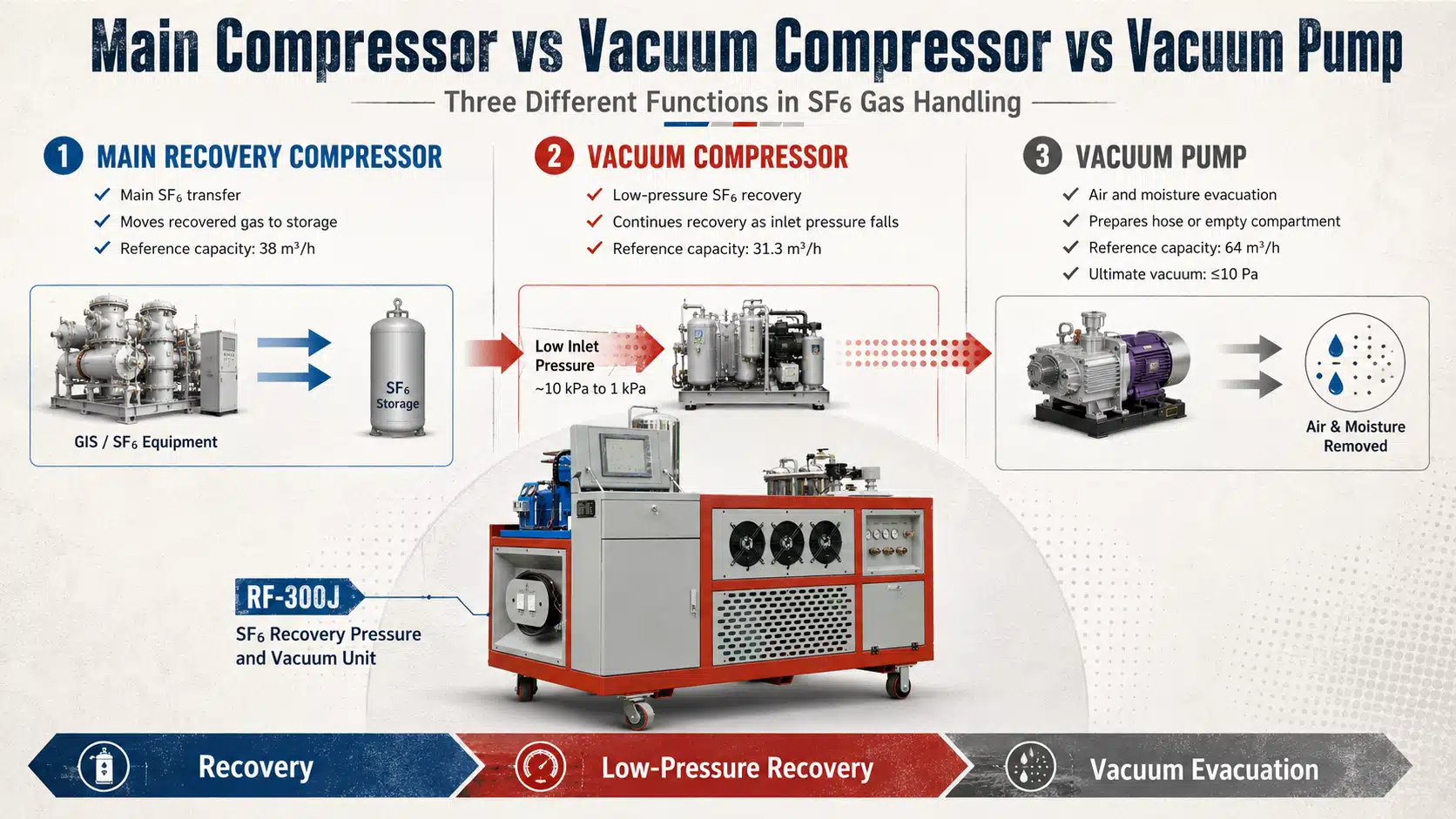
The vacuum compressor still handles SF6. It does not perform the same function as the vacuum pump.
This distinction is important:
- the vacuum compressor supports low-pressure SF6 recovery;
- the vacuum pump evacuates air and moisture.
Stage 4: Complete Recovery and Evacuate as Required
When the system reaches the specified final SF6 recovery pressure, the recovery stage ends.
If the maintenance procedure requires evacuation before refilling, technicians then use the vacuum pump to evacuate the empty gas compartment.
At that point, ultimate vacuum becomes relevant again.
The operating sequence can therefore be summarized as:
SF6 Recovery → Low-Pressure Recovery → Recovery Endpoint → Vacuum Evacuation → Refilling
This sequence explains why one integrated system may list both recovery pressure and ultimate vacuum without treating them as the same parameter.
Which Components Control Each Function?
An integrated SF6 recovery unit may use several compressors and pumps. Each component serves a defined purpose.
Main Recovery Compressor
The main compressor transfers most of the SF6 during the higher-pressure recovery stage.
It draws gas from the electrical equipment and compresses it for transfer into storage.
Its capacity affects the main recovery process, but it does not define the vacuum system’s ultimate vacuum.
Vacuum Compressor
The vacuum compressor supports low-pressure SF6 recovery.
As the gas-compartment pressure falls, it continues to draw SF6 from the source side and feeds the gas into the downstream recovery circuit.
For that reason, the vacuum compressor remains part of the SF6 recovery process.
Vacuum Pump
The vacuum pump removes air and moisture from an empty gas compartment, hose, or gas-handling circuit.
Two specifications usually describe vacuum-pump performance:
- pumping speed; and
- ultimate vacuum.
Pumping speed indicates how much gas the pump can move over time. Ultimate vacuum indicates the lowest absolute pressure the pump can reach.
These values should also be evaluated separately.
How to Read an SF6 Recovery Equipment Data Sheet
When engineers compare SF6 recovery equipment, they should group specifications by function rather than compare pressure values in isolation.
The most relevant parameters usually include:
- SF6 recovery capacity;
- maximum recovery inlet pressure;
- final recovery pressure;
- main compressor capacity;
- vacuum compressor capacity;
- vacuum pump capacity;
- ultimate vacuum;
- storage capacity; and
- refilling capacity.
One common error is to identify the lowest pressure number on the data sheet and assume that it represents the final SF6 recovery pressure.
It may not.
For example, a value listed under “ultimate vacuum” normally describes the vacuum pump. A value listed under “final recovery pressure” or “recovery stop pressure” relates to the SF6 recovery stage.
This functional distinction provides a more accurate basis for equipment comparison.
RF-300J Example: Recovery Pressure and Ultimate Vacuum
The RF-300J provides a useful example because its technical configuration separates the main recovery, low-pressure recovery, and vacuum functions.
| RF-300J Parameter | Reference Value | Function |
|---|---|---|
| Maximum Recovery Inlet Pressure | <0.6 MPa | Recovery-side inlet condition |
| Adjustable Recovery Stop Setting | 0.01–0.6 MPa | Recovery stop setting |
| Negative-Pressure Recovery Switch Point | 0.08 MPa | Transition to low-pressure recovery |
| Negative-Pressure Recovery Stop | 10 kPa / 0.01 MPa | Low-pressure recovery endpoint |
| Main Compressor | 38 m³/h | Main SF6 gas transfer |
| Vacuum Compressor | 31.3 m³/h | Low-pressure SF6 recovery |
| Vacuum Pump | 64 m³/h | Air evacuation |
| Ultimate Vacuum | ≤10 Pa | Vacuum subsystem capability |
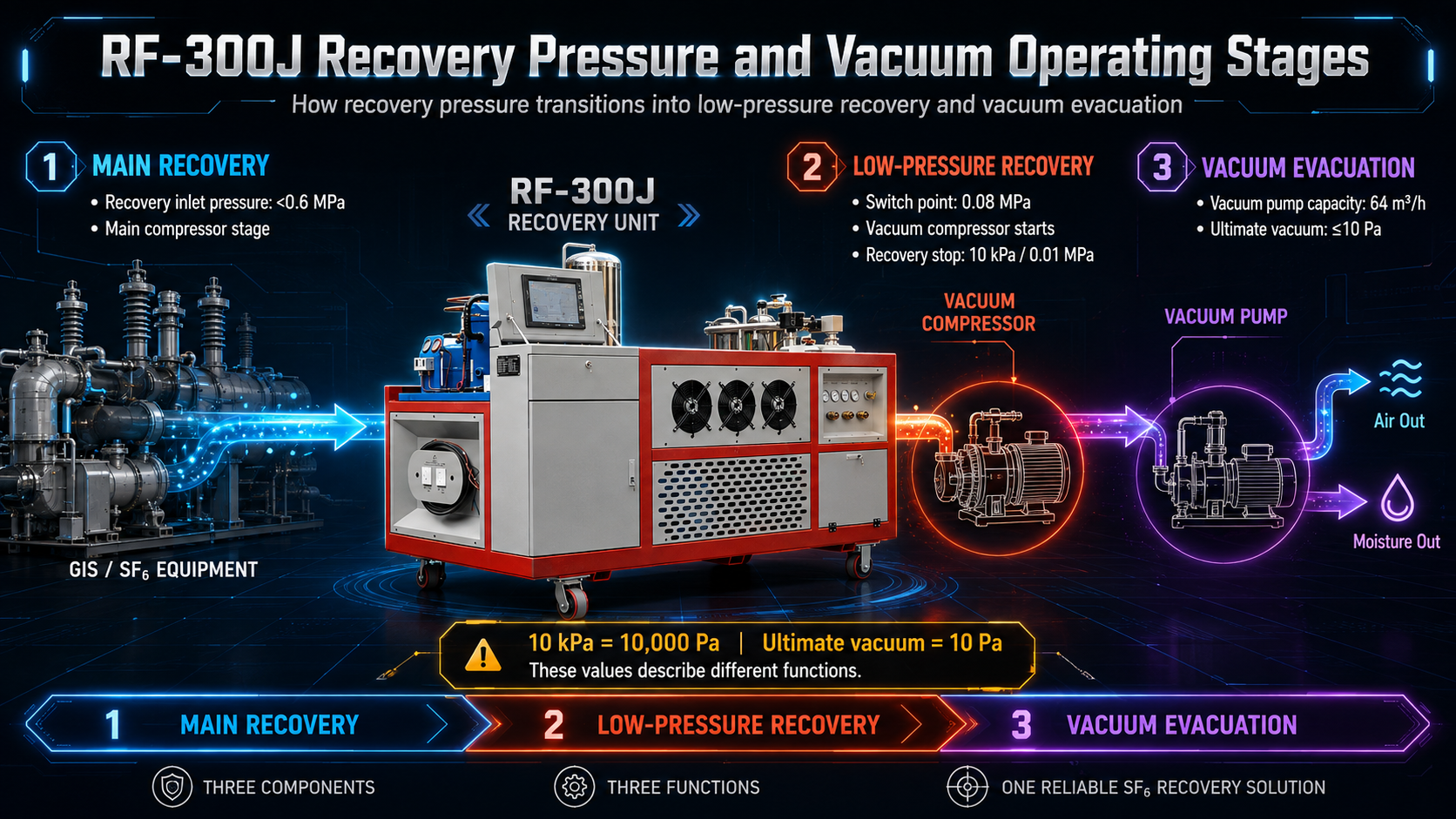
During the RF-300J recovery sequence, the system changes operating mode as recovery pressure falls.
When the source-side pressure reaches 0.08 MPa, the system switches to negative-pressure recovery and starts the vacuum compressor. The documented low-pressure recovery sequence stops at 10 kPa, or 0.01 MPa.
The vacuum system, however, has a separate ultimate-vacuum specification of ≤10 Pa.
These values illustrate the technical difference clearly.
The 10 kPa value relates to the stated low-pressure SF6 recovery endpoint. By comparison, the ≤10 Pa value describes the evacuation capability of the vacuum subsystem.
Although one value is numerically much lower than the other, the more important point is that they measure different operations.
Why the Difference Matters When Selecting an SF6 Recovery Unit
Correct interpretation of SF6 recovery pressure and ultimate vacuum helps engineers evaluate equipment according to the actual maintenance task.
For example, a project with a large SF6 inventory may place greater emphasis on:
- recovery capacity;
- compressor performance;
- low-pressure recovery capability; and
- storage capacity.
A project that requires evacuation of a large GIS compartment may also place significant emphasis on:
- vacuum-pump capacity;
- ultimate vacuum; and
- evacuation time.
Therefore, selecting an SF6 recovery unit based on one pressure value does not provide a complete technical comparison.
Engineers should evaluate the entire gas-handling process.
What Should an SF6 Recovery Equipment RFQ Include?
A clear RFQ should separate recovery requirements from vacuum requirements.
The project team should provide, where available:
- GIS or switchgear gas quantity;
- initial gas pressure;
- required final SF6 recovery pressure;
- required vacuum condition;
- gas-compartment volume;
- storage requirement;
- available site power supply;
- required recovery time; and
- purification or reuse requirements.
This information allows the equipment supplier to evaluate the main compressor, vacuum compressor, vacuum pump, storage system, and control sequence separately.
For example, a requirement that states only “ultimate vacuum ≤10 Pa” does not define how much SF6 the system must recover or what final recovery pressure the GIS requires.
Likewise, providing only the SF6 gas quantity does not define the evacuation requirement.
For project-specific technical review, engineers may share the GIS gas quantity, initial pressure, target recovery pressure, vacuum requirement, and storage arrangement with [email protected]. Those operating conditions provide a practical basis for discussing the correct recovery and evacuation configuration.
Frequently Asked Questions
Is Final SF6 Recovery Pressure the Same as Ultimate Vacuum?
No.
Final SF6 recovery pressure defines the endpoint of the SF6 recovery stage. Ultimate vacuum defines the lowest absolute pressure that the vacuum subsystem can achieve during evacuation.
They measure different functions.
Why Does an SF6 Recovery Unit Use Both a Vacuum Compressor and a Vacuum Pump?
The vacuum compressor supports low-pressure SF6 recovery.
The vacuum pump removes air and moisture from an empty compartment or gas-handling circuit.
Although both operate at reduced pressure, they perform different tasks.
Does a Lower Ultimate Vacuum Mean Better SF6 Recovery?
Not necessarily.
A lower ultimate vacuum indicates deeper evacuation capability. SF6 recovery performance also depends on the main compressor, vacuum compressor, gas flow path, storage system, and operating conditions.
Therefore, engineers should evaluate recovery performance and vacuum performance separately.
What Determines Final SF6 Recovery Pressure?
The required final SF6 recovery pressure depends on the GIS design, maintenance procedure, project specification, and recovery-equipment capability.
No single value applies to every GIS installation.
Which Parameter Matters More for GIS Maintenance?
Neither parameter is universally more important.
SF6 recovery pressure matters during gas removal. Ultimate vacuum matters during evacuation of air and moisture.
The relevant parameter depends on the operating stage.
How Should SF6 Recovery Pressure Be Specified in an RFQ?
The RFQ should identify the initial gas pressure, required final recovery pressure, and whether low-pressure recovery is required.
The required vacuum condition should appear as a separate specification.
This structure reduces ambiguity during technical evaluation.
Recovery Pressure and Ultimate Vacuum Measure Different Tasks
SF6 recovery pressure and ultimate vacuum may appear together on an SF6 recovery equipment data sheet, but they should never be treated as interchangeable specifications.
SF6 recovery pressure tracks the source-side condition while the recovery system removes gas from GIS or switchgear. As that pressure falls, the system may transition from the main compressor to a low-pressure recovery stage.
Ultimate vacuum describes a different function. It defines the evacuation capability of the vacuum subsystem when the system removes air and moisture from a hose, gas circuit, or empty compartment.
For that reason, equipment selection should begin with the gas-handling process, not with the smallest pressure value on the data sheet.
When equipment owners, field technicians, and SF6 equipment engineers clearly separate gas recovery, low-pressure recovery, vacuum evacuation, storage, and refilling, they can evaluate technical specifications more accurately. They can also communicate project requirements in a common engineering language: starting pressure, recovery endpoint, vacuum requirement, gas quantity, and storage configuration.
That approach produces clearer RFQs, more accurate equipment comparisons, and more reliable GIS maintenance planning.