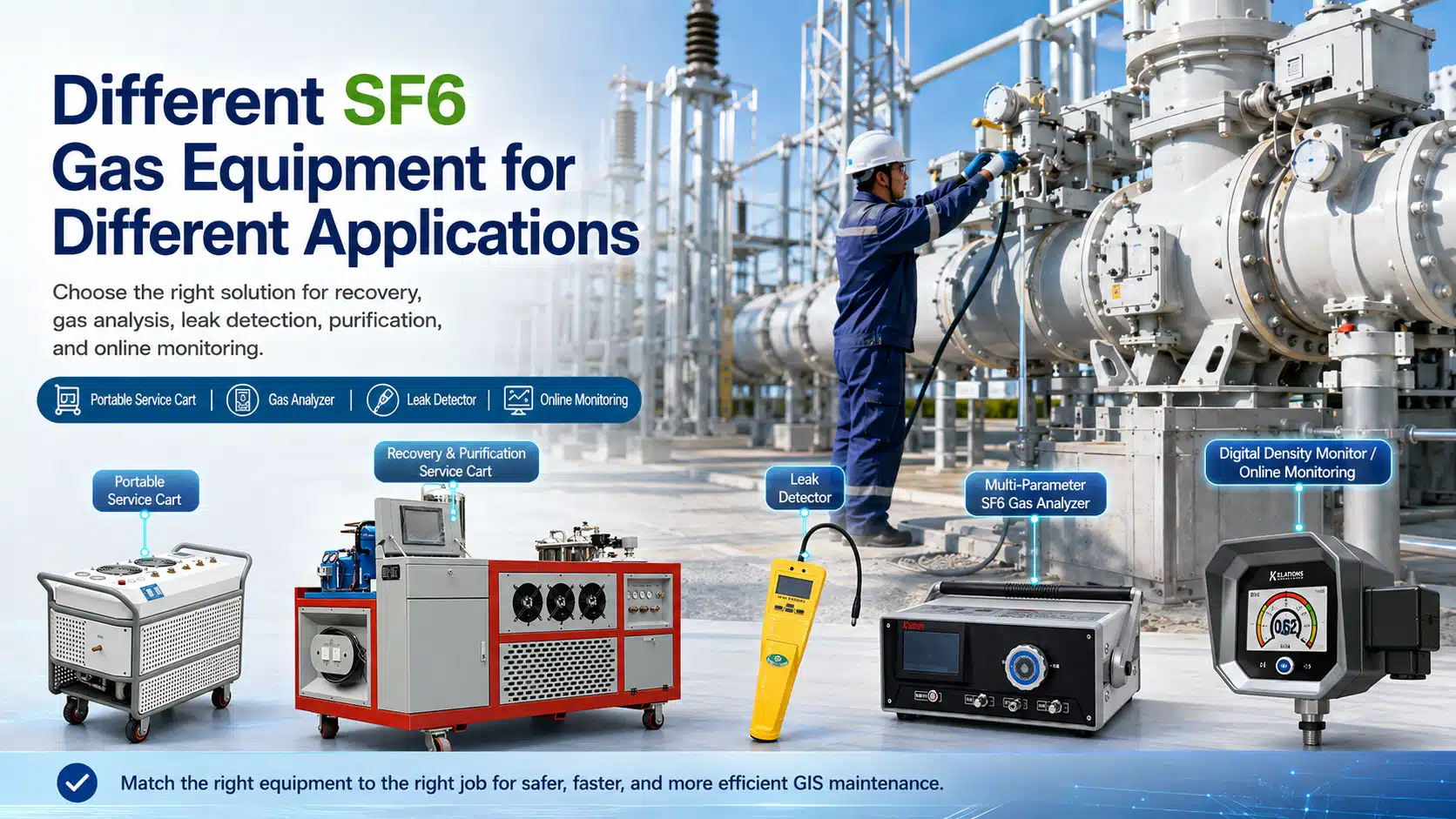
SF6 gas equipment is used throughout the installation, commissioning, maintenance, and overhaul of GIS, GIL, circuit breakers, and other gas-insulated electrical equipment. Depending on the task, technicians may need to recover SF6, evacuate a gas compartment, analyze gas quality, locate leaks, purify recovered gas, or monitor gas conditions continuously.Using the wrong equipment can extend recovery time, increase gas losses, complicate field operations, or leave the actual maintenance problem unresolved. Correct selection does the opposite. It improves process efficiency, supports safer gas handling, reduces unnecessary SF6 consumption, and helps maintenance teams keep the project on schedule.The principle is straightforward:Different applications require different SF6 gas equipment.
Why Does SF6 Gas Handling Need Different Equipment?
SF6 gas handling is a process, not one task:Recovery → Purification → Evacuation → Filling → Gas Analysis → Leak Detection → Monitoring.For example,each step has a clear role. A service cart moves gas. An analyzer checks gas quality. A leak detector finds leaks. An online monitor tracks gas condition over time.Selection should start with the job, gas volume, gas type, final recovery pressure, and site conditions.
Small Gas Compartments: Choose a Compact Service Cart
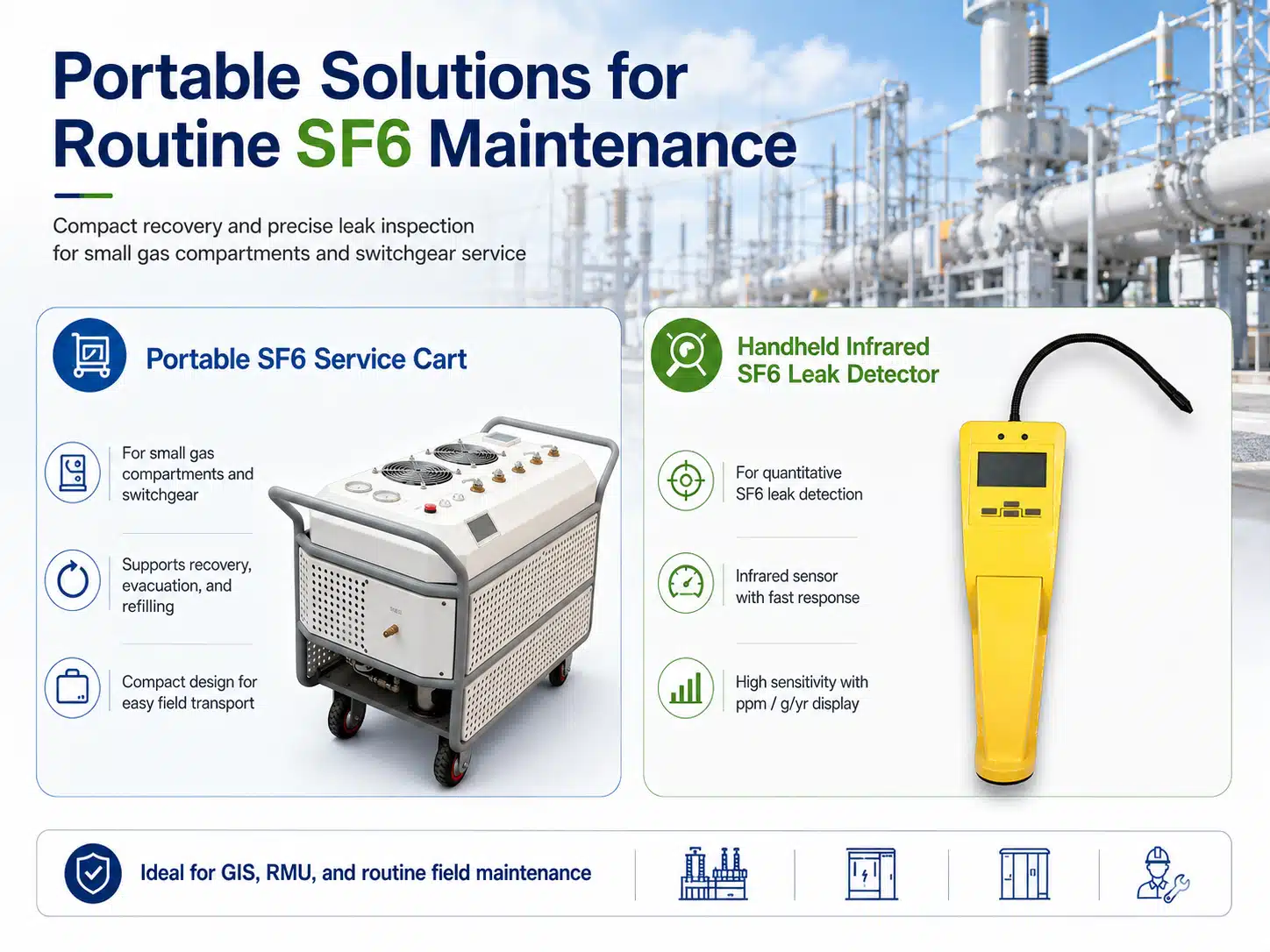
For small switchgear and compact gas compartments, easy transport often matters more than high flow.A portable SF6 service cart can support recovery, evacuation, and filling during routine work. It suits medium-voltage switchgear, ring-main units, and other small gas compartments.A larger cart may take more space and add transport work without saving much time. Therefore, compact service equipment is often the better choice for small-volume jobs.
Large GIS and GIL: Focus on Recovery Capacity
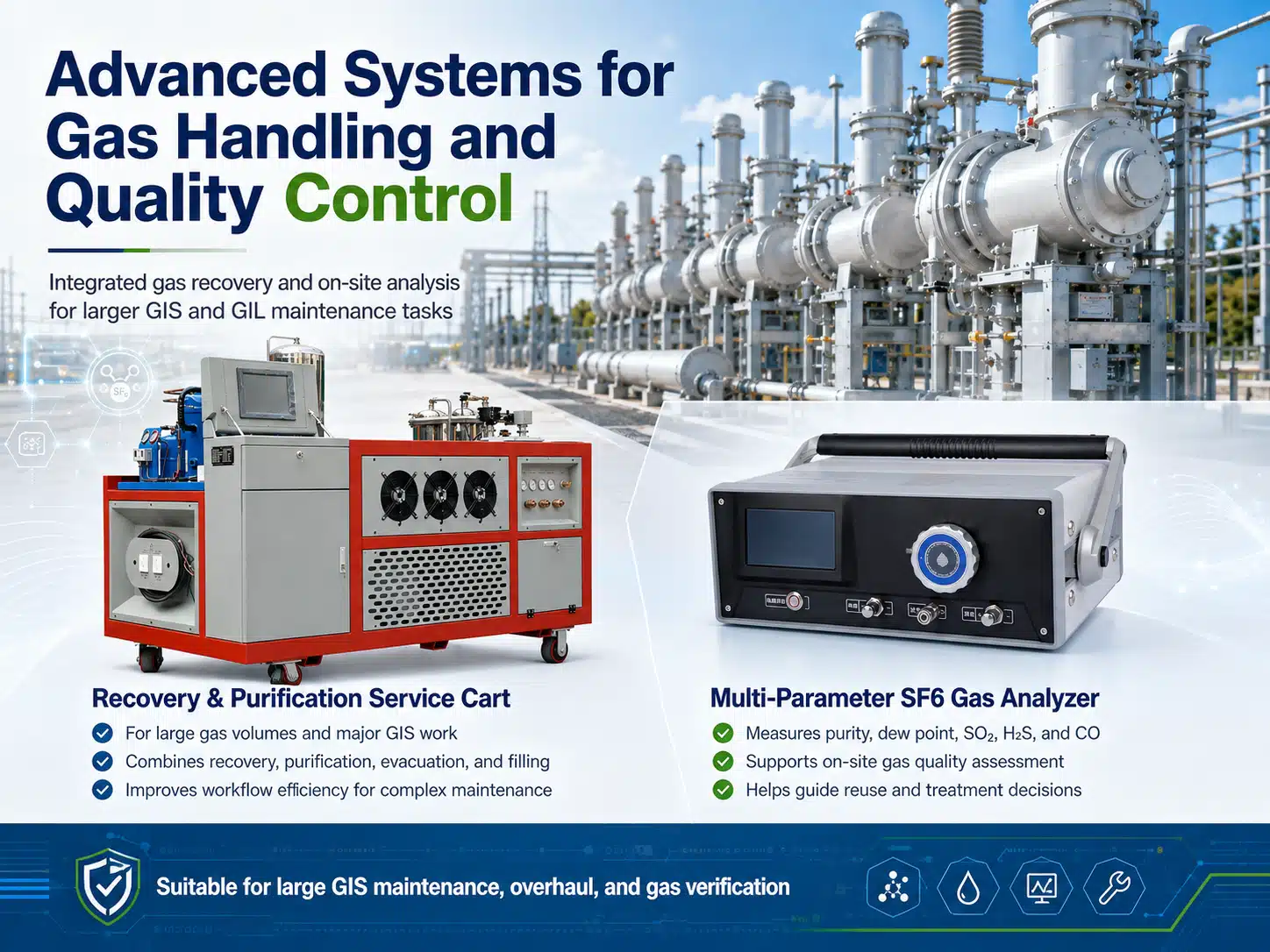
Large GIS and GIL systems hold more gas and may have many compartments. Recovery time then depends on compressor output, hose size, storage volume, cooling, and final recovery pressure.A large recovery and purification cart can combine:Recovery → Purification → Evacuation → Filling.As a result, technicians need to move and connect fewer machines during one job.However, low-pressure performance also matters. A unit may recover gas fast at first but slow down as pressure falls.Therefore, buyers should review the full recovery process, not only the top flow rate.
Field Example: 1000 kV UHV Maintenance.During a 1000 kV UHV substation project, our field team handled the full SF6 process. This included recovery, purification, evacuation, refilling, gas checks, leak inspection, and records.The work involved large gas volumes, several GIS compartments, and many connection points. Therefore, the project required more than gas recovery alone. It required a complete gas-handling process.
Gas Quality: Use an SF6 Gas Analyzer
Recovered SF6 may contain moisture, decomposition products, or other impurities. Before reuse, technicians need to know its condition.A multi-parameter SF6 gas analyzer can check purity, dew point, SO2, H2S, CO, and other selected parameters.However, purity alone does not show the full gas condition. Moisture and decomposition products also provide useful information. In addition, a gas return system can reduce sample loss at sites with many test points.
Gas Leaks: Use an SF6 Leak Detector
A drop in gas density may show that the equipment is losing gas. It does not show where the leak is.A handheld infrared SF6 leak detector can check flanges, valves, seals, fittings, service ports, and instrument joints.This helps teams fix the cause instead of only adding more gas.The detector must also match the site. Technicians should check the gas type, response time, probe design, work temperature, and explosion-protection before use.
Continuous Operation: Use Online SF6 Monitoring
Portable tools give data during an inspection. Online systems provide data between inspections.A digital SF6 density monitor can track density, pressure, and temperature over time. If gas density keeps falling, maintenance teams can plan service before the issue becomes more serious.Room monitoring has a different role. In indoor substations, a gas alarm system can monitor SF6, oxygen, temperature, and humidity. It can also link to alarms or ventilation.One system watches the gas inside the equipment.The other watches the work area.
Purification and Mixed Gas Need Dedicated Systems
Recovery does not mean the gas is ready for reuse.If recovered SF6 contains too much moisture or other contaminants, deeper treatment technicians may need deeper treatment. A purification system can support this process:Recover → Treat → Analyze → Verify → Reuse where suitable.This can improve gas use and reduce the need for new SF6.Technicians should still check the treated gas before reuse.SF6/N2 mixtures also need a different plan from pure SF6. They may require dedicated recovery, separation, analysis, monitoring, mixing, and filling systems.Buyers should confirm the gas type before they select SF6 gas equipment.
Large Projects: Consider an Integrated Gas Handling Workstation
For large GIS and GIL projects, the main issue is often work flow.A large project may require recovery, storage, purification, evacuation, filling, analysis, leak checks, gas-batch control, and records at one site.An integrated mobile SF6 gas handling workstation brings these tasks into one platform. It suits large high-voltage and UHV projects with many gas compartments and a fixed work plan.Its main value is not only higher capacity,it is better process control.
How to Choose the Right SF6 Gas Equipment
Before comparing models, define the real job:
Gas Volume and Final Pressure
Small compartments need less capacity. Large GIS systems need more flow, storage, and strong low-pressure performance.If the unit is too small, work takes longer. If it is too large, cost and transport needs may rise without much gain.Also check the required final recovery pressure. A high top flow rate does not always mean a short total recovery time.
Gas Type and Site Conditions
Confirm whether the system uses pure SF6 or an SF6/N2 mixture. Gas type affects the analyzer, leak detector, density monitor, recovery system, and filling equipment.Also check access, work space, ambient temperature, power supply, hose length, coupling size, ventilation, and explosion-protection needs.A strong machine has little value if it cannot reach the work point.
Required Work Flow
Some jobs need only leak detection. Others need a full process:Recovery → Evacuation → Analysis → Purification → Filling → Leak Check.The more steps that must work together, the more useful an integrated system may be.
Why Correct Selection Saves Money
The purchase price of SF6 gas equipment is only one part of the total cost.Correct selection can reduce recovery time, labor hours, gas loss, repeat filling, machine moves, and project delays.A recovery cart that matches the gas volume can shorten the work window. A leak detector can help stop repeat gas loss. A gas analyzer can show whether recovered SF6 needs treatment or can move to the next step.Better gas handling can also support reuse and reduce the need for new SF6.
Better Gas Handling Also Supports Environmental Goals
Good SF6 gas handling can reduce avoidable emissions.Efficient recovery keeps more gas in the system. Leak detection finds loss points. Gas analysis and purification can support reuse. Online monitoring can show slow gas loss before it becomes a larger issue.The goal is simple:Recover well → Find leaks → Check gas quality → Treat when needed → Reuse where suitable.When operators prevent gas loss, they also reduce the need for replacement gas.
FAQ About SF6 Gas Equipment
What is this equipment used for?
Technicians use this equipment for recovery, evacuation, filling, and purification. They also use it for gas analysis, leak detection, and density monitoring.
How do I choose SF6 recovery equipment?
Check gas volume, compartment size, final recovery pressure, target recovery time, storage capacity, hose size, connection type, and site access.
Can the same system handle pure SF6 and SF6/N2?
Not always. Mixed gas may need dedicated systems for recovery, separation, analysis, monitoring, and filling.
Match the Equipment to the Application
A small switchgear job and a 1000 kV GIS overhaul both involve SF6, but the work is very different.
Small jobs need portability. Large GIS systems need more recovery capacity. Gas quality issues need analysis. Leaks need detection. Long-term operation needs monitoring. Contaminated gas may need purification, while mixed gas needs its own handling system.The application should define the SF6 gas equipment.When the system fits the real work, installation and maintenance can become faster, easier to manage, and more cost-effective. Better recovery, leak control, gas checks, and reuse can also reduce avoidable SF6 loss.
For projects where gas volume, final pressure, gas type, site access, or required functions make the choice less clear, project details can be shared with [email protected] before the final setup is chosen.Select the application first. Then select the equipment.