SF6 Gas Equipment: A Guide for High-Voltage Equipment Maintenance
Introduction
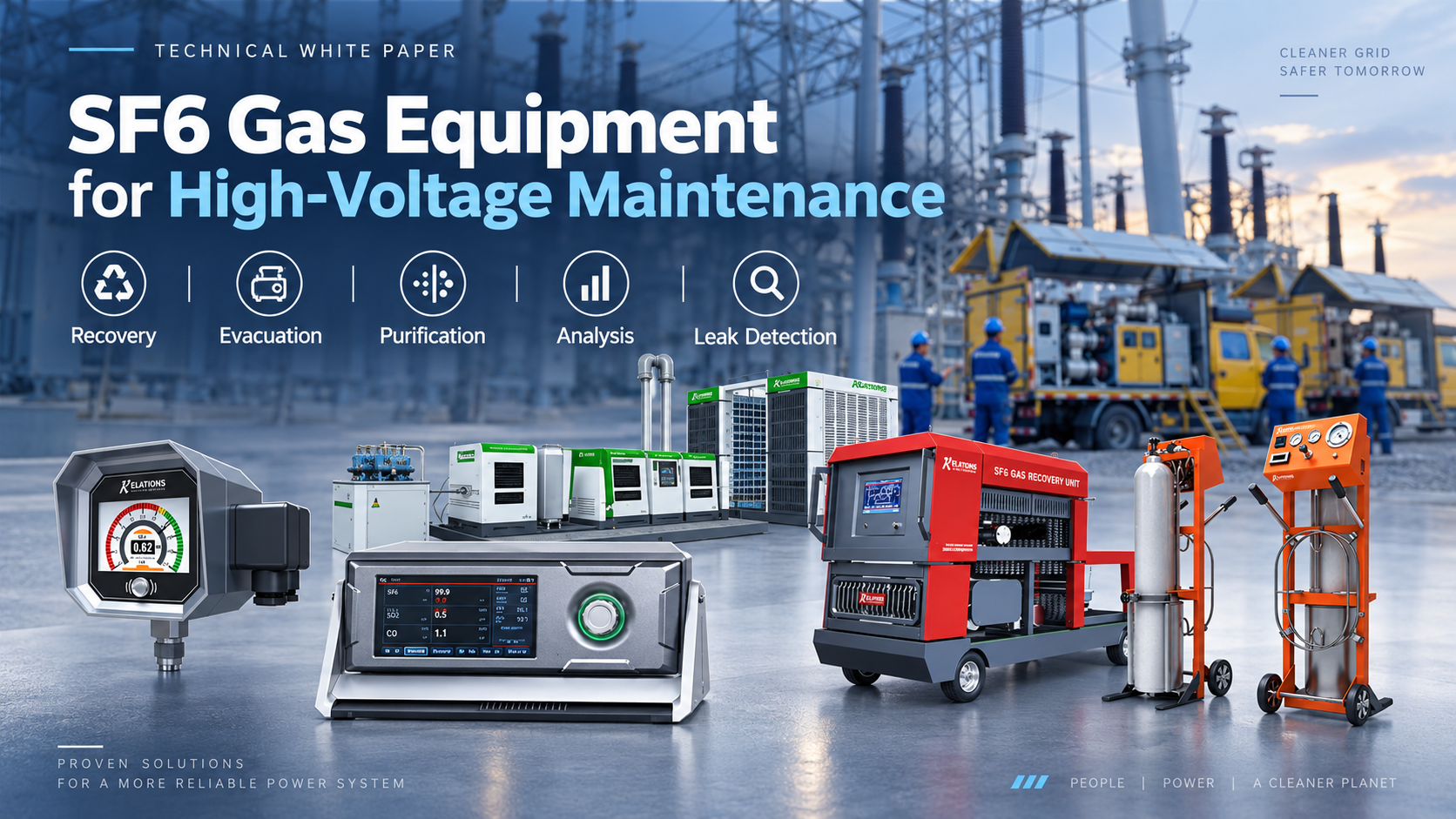
SF6 gas equipment is used to maintain high-voltage electrical equipment. Utilities, GIS service contractors, switchgear manufacturers, and substation teams use it to recover, store, purify, refill, analyze, and monitor SF6.
The equipment supports SF6 recovery before maintenance, removes air and moisture from gas compartments, refills equipment to the required pressure, checks gas quality, and locates leaks.
This guide explains what SF6 gas equipment does and what buyers should consider when selecting equipment for high-voltage maintenance.
What Problems Does SF6 Gas Equipment Solve?
Buyers usually need SF6 gas equipment for specific maintenance tasks. These may include servicing a GIS bay, replacing a circuit breaker component, recovering gas from old equipment, or checking a drop in gas pressure.
One issue is SF6 gas loss. Before maintenance, SF6 should be recovered instead of released into the atmosphere. Without an SF6 gas recovery and filling unit, gas handling may be slow and difficult to control. Gas loss also increases operating costs.
Gas quality is another concern. During service, SF6 may contain moisture, air, decomposition products, or particles. If contaminated gas is reused without purification or filtration, it may affect insulation performance and equipment reliability.
Leaks can also be difficult to locate, especially in GIS installations with many flanges, valves, seals, and pipe connections. Undetected leaks can reduce gas pressure and lead to alarms or unplanned maintenance.
Vacuum performance also affects maintenance. Before SF6 filling, the gas compartment must be evacuated to remove air and moisture. If the vacuum pumping unit cannot handle the compartment volume, evacuation takes longer and gas quality may be affected.
Buyers may also need to choose between a compact evacuation and refilling unit, a recovery and purification system, a vacuum pumping unit, or an integrated system with gas analysis and leak detection.
The choice depends on gas volume, application, maintenance frequency, and gas-quality requirements.
Why SF6 Gas Equipment Selection Matters
SF6 gas equipment should match the maintenance process.
Recovery equipment removes SF6 before GIS, circuit breakers, or other gas-insulated equipment is opened. This reduces gas loss and prevents uncontrolled discharge.
Purification systems remove moisture, oil, particles, and certain impurities through filters and drying components. This allows recovered gas to be treated before reuse.
Recovery speed, vacuum performance, and filling control also affect maintenance time. This matters when equipment downtime must be limited.
Gas analysis and leak detection provide data for maintenance decisions. Engineers can check gas purity, moisture, decomposition condition, and leak locations before deciding what action to take.
Key Benefits for Utilities and Maintenance Teams
Efficient SF6 Gas Recovery
SF6 gas recovery is required before GIS or circuit breakers are opened for maintenance.
A recovery unit transfers SF6 from the equipment to a storage tank or gas cylinder under controlled pressure.
Recovery speed and final recovery pressure affect both maintenance time and gas loss.
When comparing equipment, buyers should check gas volume, pressure range, and operating conditions.
Stable Vacuum Performance
After recovery and before filling, the gas compartment must be evacuated.
Vacuum evacuation removes air and moisture. Residual moisture can affect insulation performance and contribute to unwanted by-products.
The vacuum pumping unit should match the gas-compartment volume and required vacuum level.
For large GIS compartments, pumping capacity has a direct effect on evacuation time.
SF6 Gas Recycling and Purification
Recovered SF6 may be reused after treatment and testing.
SF6 purification systems use filters, drying materials, and other components to remove contaminants.
Purification can reduce the need for new SF6 and support gas reuse across multiple maintenance projects.
Field Operation
Field equipment should be easy to move, connect, and operate.
Operators may need to move the unit between bays, connect hoses, monitor pressure, and complete recovery or filling within a maintenance window.
Controls, valves, gauges, connections, and equipment layout should support these tasks.
SF6 Leak Detection
SF6 leak detection is used around flanges, seals, valves, gas lines, and equipment joints.
Portable SF6 leak detectors are commonly used during routine inspection and after maintenance.
Leak detection helps confirm that the equipment is sealed before it returns to service.
Gas-Quality Testing and Records
SF6 gas analyzers and purity analyzers are used before filling, after recovery, or during inspection.
Depending on the analyzer, users may measure SF6 purity, moisture, and other gas-condition parameters.
Measurement records help teams compare gas condition over time and decide whether gas should be reused, purified, or replaced.
Common Applications of SF6 Gas Equipment
SF6 gas equipment is used in GIS maintenance, circuit breaker maintenance, substation service, manufacturing, commissioning, and field projects.
During GIS maintenance, teams may need gas recovery, vacuum evacuation, filling, leak detection, and gas analysis.
SF6 circuit breaker maintenance may require recovery and refilling equipment, gas storage tanks, vacuum pumps, and leak detectors.
Transformer maintenance may also require gas-handling equipment when SF6-insulated components are involved.
Substation teams use gas analyzers, purity analyzers, hoses, valves, filters, and accessories for inspection and service.
Switchgear manufacturers use SF6 filling, evacuation, and testing equipment during production and factory testing.
EPC contractors and service companies may use mobile SF6 recovery systems during installation, commissioning, and maintenance.
Buyer’s Guide: How to Choose SF6 Gas Equipment
Buyers should evaluate the full gas-handling process before selecting equipment.
The main factors are gas volume, maintenance frequency, site conditions, gas-quality requirements, and operating needs.
Check Recovery Speed and Final Recovery Pressure
Recovery speed determines how long the team must wait before opening the equipment.
A small recovery unit may be too slow for large GIS compartments.
Buyers should also check final recovery pressure. Lower final recovery pressure can reduce the amount of SF6 left in the equipment.
Review Vacuum Level and Pumping Capacity
The vacuum system must meet the required vacuum level within the available maintenance time.
Larger gas compartments require higher pumping capacity.
Buyers should compare the required vacuum level with the vacuum pump capacity.
Understand Gas Purity Requirements
If recovered SF6 will be reused, purification and analysis are required.
Buyers should check whether the filtration system removes moisture, particles, oil, and other contaminants relevant to the application.
An SF6 gas analyzer can then be used to check gas quality before reuse.
Evaluate Compressor and Storage Capacity
The compressor affects gas transfer, pressure handling, and recovery performance.
Storage capacity must also match the expected gas volume.
Buyers should determine whether the application requires cylinders, separate storage tanks, or an integrated storage system.
Consider Mobility and Site Conditions
Substation equipment often needs to move between bays or sites.
Wheels, lifting points, hose storage, and compact dimensions can make transport easier.
For outdoor use, buyers should also consider dust, humidity, temperature, and transport conditions.
Review Controls and Safety Protection
The control panel should be clear and easy to operate.
Safety functions may include pressure protection, temperature protection, electrical protection, emergency stop, and secure hose connections.
The operating system should match the maintenance team’s working procedures.
Confirm Accessory and Connection Compatibility
Hoses, valves, couplings, filters, regulators, and adapters affect gas flow and sealing.
Incorrect components may cause leaks, restricted flow, or connection problems.
Buyers should confirm compatibility with GIS, circuit breakers, gas cylinders, and other equipment connections.
Evaluate Service Support and Customization
Different applications require different configurations.
Utilities may need equipment for multiple substations. Switchgear manufacturers may need systems for production-line filling. Service contractors may need mobile units with flexible connections.
Customization may include tank capacity, control system, voltage, interface language, hose length, filtration configuration, and analyzer options.
Buyers should also check technical documentation, training, spare parts, maintenance support, and after-sales service.
FAQ
1. What SF6 gas equipment is needed for basic substation maintenance?
A basic setup may include an SF6 gas recovery and filling unit, vacuum pumping equipment, gas storage cylinders or tanks, hoses, valves, an SF6 gas analyzer, and a leak detector.
The configuration depends on equipment size and maintenance frequency.
2. Can recovered SF6 gas be reused?
Yes, in many cases, if the gas is filtered, purified, and tested before reuse.
SF6 purification equipment treats the gas, while an SF6 gas analyzer checks gas quality before filling.
3. Why is vacuum evacuation required before SF6 filling?
Vacuum evacuation removes air and moisture from the gas compartment.
Residual air or moisture may affect gas quality and insulation performance.
4. How should buyers choose between a compact unit and a large SF6 recovery system?
A compact evacuation and refilling unit may be suitable for smaller equipment, lower gas volumes, or occasional maintenance.
A larger recovery and purification system is more suitable for large GIS compartments, frequent maintenance, faster recovery, or gas-reuse applications.
5. Why should an SF6 leak detector be used after maintenance?
Maintenance may involve seals, valves, flanges, or other gas-system connections.
A leak detector checks whether these areas remain sealed before the equipment returns to service.
Selecting SF6 Gas Equipment
SF6 gas equipment supports recovery, evacuation, filling, purification, gas analysis, and leak detection during high-voltage equipment maintenance.
Buyers should select equipment based on recovery speed, final recovery pressure, vacuum performance, purification requirements, storage capacity, mobility, safety functions, connection compatibility, and service support.
The right configuration can reduce maintenance time, limit SF6 loss, and support equipment operation.
We provide SF6 gas recovery and filling units, evacuation and refilling devices, recovery and purification systems, vacuum pumping units, gas analyzers, purity analyzers, leak detectors, storage tanks, filters, hoses, valves, and related accessories for GIS, circuit breakers, transformers, substations, and other high-voltage equipment.
If you are planning to purchase SF6 gas equipment, contact us through [email protected] for product selection, technical support, or a customized SF6 gas-handling configuration.