Why Is SF6 Gas Still Important During the SF6-Free Transition?
The power industry is moving toward SF6-free technology, but SF6 gas is not disappearing from the grid. For decades, sulfur hexafluoride has been widely used in gas-insulated switchgear, circuit breakers, and other high-voltage equipment because it provides strong electrical insulation, effective arc interruption, and compact equipment design.
Environmental concerns, new regulations, and advances in alternative technologies are now reducing the use of SF6 in new equipment. At the same time, many SF6 switchgear systems remain in service. The industry therefore has to manage two things at once: the adoption of SF6-free technology and the continued operation of existing SF6 equipment.
Why Is SF6 Gas Still Widely Used?
SF6 became widely used because it combines several properties that are valuable in switchgear design. Its high dielectric strength supports compact insulation systems, while its arc-interruption performance has made it useful in circuit breakers. These characteristics are especially important in GIS and high-voltage equipment, where space, reliability, and electrical performance are major design considerations.
Utilities also have decades of operating experience with SF6 equipment. Maintenance procedures, gas-handling practices, condition assessment, and service methods are well established across a large installed base. Alternative technologies are now available for many applications, but their suitability still depends on voltage level, equipment design, operating requirements, and project conditions.
Why Is the Power Industry Moving Away from SF6 Gas?
The main concern is environmental. SF6 is a powerful greenhouse gas with a global warming potential far higher than carbon dioxide. Emissions can occur through equipment leakage, maintenance activities, or poor gas-handling practices, so reducing unnecessary releases has become an important goal for utilities and regulators.
At the same time, SF6-free technologies have advanced significantly. Medium-voltage switchgear increasingly uses vacuum interruption with non-fluorinated insulation media such as clean air or gas mixtures based on nitrogen, oxygen, or carbon dioxide. Alternative designs are also being introduced at higher voltage levels.
Utilities therefore consider more than electrical performance when selecting new switchgear. Emissions, regulations, cost, equipment availability, and long-term operating requirements now play a larger role in the decision.
What Is Changing During the SF6-Free Transition?
The biggest change is in new installations. The EU F-Gas Regulation introduces restrictions on new electrical switchgear that uses fluorinated greenhouse gases. One major deadline began on January 1, 2026, for medium-voltage switchgear for primary and secondary distribution up to and including 24 kV, subject to the derogations specified in the regulation. Additional restrictions apply to other voltage classes in later years.
The transition is progressing at different rates across voltage levels and applications. SF6-free solutions are already established for many medium-voltage applications. At higher voltages, the transition can be more difficult because equipment must meet stricter insulation, switching, and reliability requirements.
These changes are mainly affecting new equipment. Existing SF6 switchgear that remains suitable for service will continue to operate under the applicable maintenance and regulatory requirements.
Why Existing SF6 Switchgear Still Matters
Many SF6-filled GIS systems, circuit breakers, and other switchgear assets will remain in service during the transition. Replacing equipment that still meets operational requirements is not always practical, especially when power equipment is designed for long service lives.
Existing equipment still requires regular maintenance and proper SF6 gas management. SF6 may need to be recovered before a gas compartment is opened. After maintenance, the compartment may require evacuation and refilling. Gas analyzers can check purity, moisture, and decomposition products when analysis is required. Portable leak detectors help locate suspected leak points, while fixed monitoring systems can supervise gas density, pressure, or ambient SF6 conditions depending on the system design.
The need to manage SF6 therefore continues even as its use in new equipment declines.
How Is the Role of SF6 Gas Changing?
For many years, SF6 was closely associated with new switchgear, initial filling, commissioning, and the expansion of SF6-based installations. As new equipment moves toward SF6-free designs, the focus is shifting to the SF6 already contained in existing equipment.
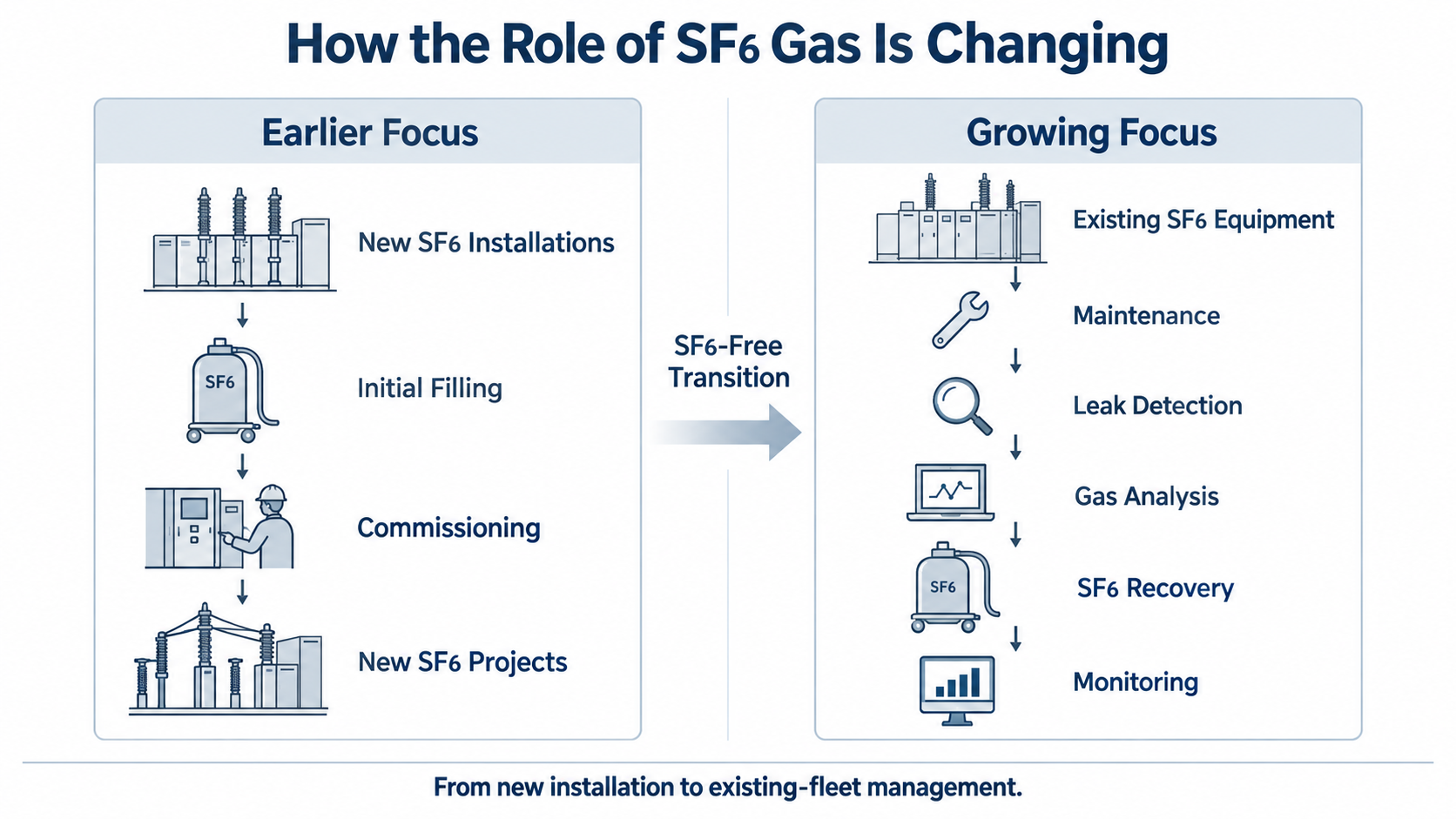
| Earlier Focus | Growing Focus During the Transition |
|---|---|
| New SF6 installations | Existing SF6 switchgear |
| Initial filling | Maintenance and refilling |
| Commissioning | Leak detection and monitoring |
| Expansion of SF6 projects | SF6 recovery and emissions control |
| New equipment lifecycle | Management of the installed fleet |
SF6 is therefore becoming less important for new installations and more closely associated with the maintenance of existing equipment. Maintenance needs will vary by equipment type, condition, site requirements, and replacement plans.
Why Will the SF6-Free Transition Take Time?
The first reason is service life. High-voltage switchgear is a long-term infrastructure investment, and many systems remain in service for decades. SF6 equipment installed before current phase-out deadlines may therefore stay on the grid for many years.
The second reason is that SF6-free technology is not developing at the same pace for every application. Medium-voltage solutions are already widely available, while some high-voltage applications require more engineering development, operating experience, supply-chain capacity, or investment before they can be widely adopted.
Grid expansion must also continue during the transition. Electricity demand, renewable-energy integration, electrification, and grid reinforcement all require new switchgear and circuit breakers. The industry must reduce its dependence on SF6 without compromising power-system reliability.
What Comes Next for SF6 Gas?
New switchgear will use less SF6 as SF6-free technologies become more widely available and regulatory restrictions expand. Existing SF6 equipment, however, will remain in service for many years and will still require maintenance, gas recovery, analysis, leak detection, and monitoring.
SF6 gas therefore remains important during the transition—not because its use in new equipment is growing, but because the existing SF6 fleet still has to be managed properly.