SF6 Gas Equipment for Existing Switchgear After 2026
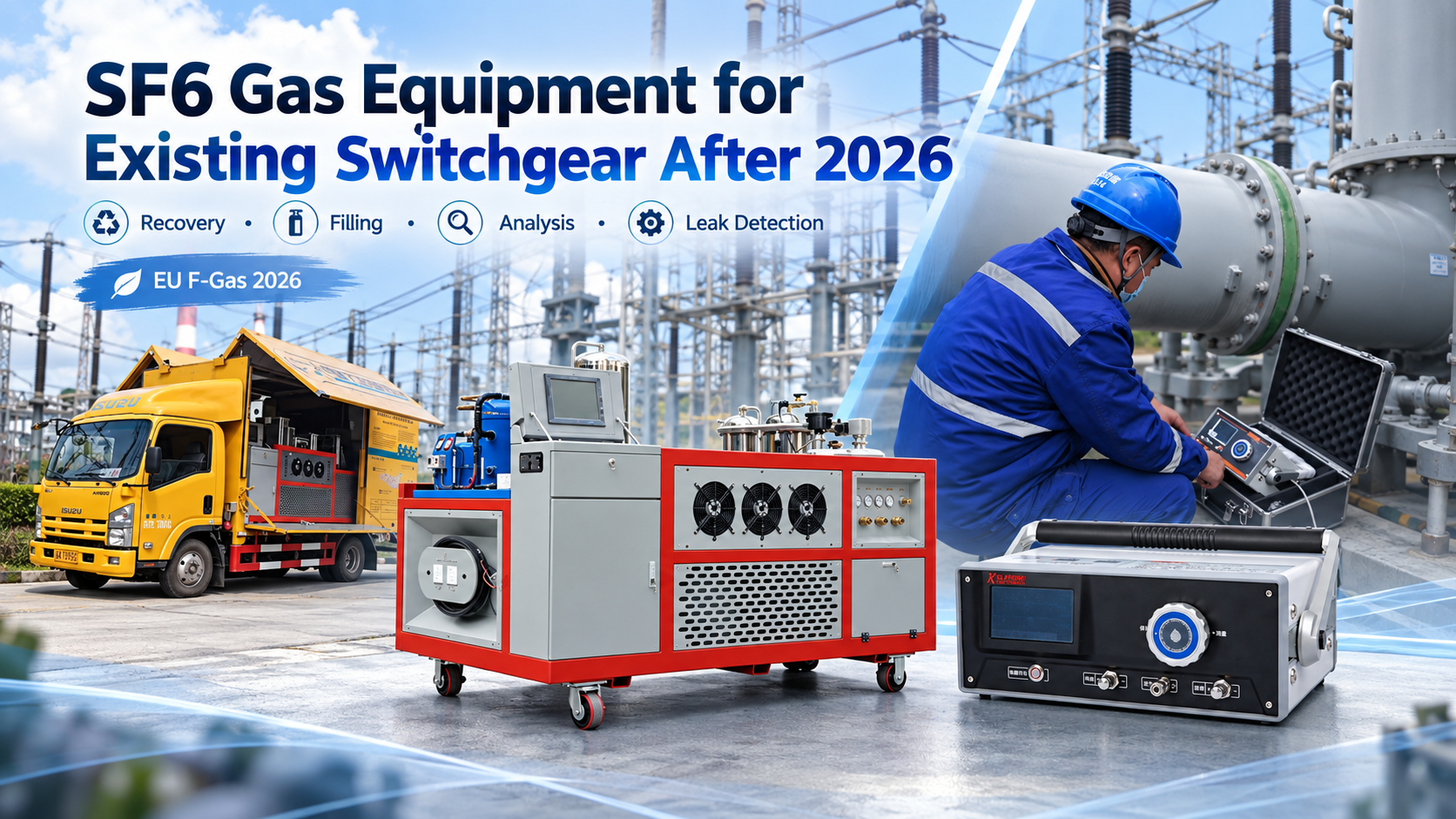
SF6 gas equipment is still needed under the 2026 EU F-Gas Rules, but its main applications are changing.
The new rules restrict the use of fluorinated greenhouse gases in certain new electrical switchgear. Existing SF6 switchgear, however, remains in service and still requires maintenance, SF6 gas handling, SF6 gas analysis, leak detection, monitoring, and eventual decommissioning.
As a result, this equipment is increasingly used for maintaining and servicing existing switchgear rather than supporting new SF6 installations.
What Changes for SF6 Switchgear in 2026?
From January 1, 2026, Regulation (EU) 2024/573 prohibits the putting into operation of medium-voltage electrical switchgear for primary and secondary distribution up to and including 24 kV when it uses, or relies on, fluorinated greenhouse gases as an insulating or breaking medium. The regulation also provides specific derogations.
This 2026 requirement concerns the putting into operation of specified switchgear. It does not, by itself, require existing SF6 switchgear already in service to be taken out of operation.
The focus is therefore increasingly on maintaining and servicing existing SF6 switchgear throughout its remaining service life.
Why Existing SF6 Switchgear Still Needs Gas Handling Equipment
Existing SF6 switchgear may still require SF6 gas handling during:
- Maintenance
- Servicing
- Gas compartment maintenance
- SF6 gas recovery
- Evacuation
- SF6 refilling
- SF6 gas analysis
- SF6 leak detection
- Decommissioning
EU F-Gas requirements continue to address emissions prevention, servicing, leak checks where applicable, gas recovery, and equipment decommissioning.
Each maintenance task may require different SF6 gas handling equipment.
Which SF6 Gas Equipment Is Still Needed?
The table below gives a quick overview of the main maintenance tasks and the equipment used for each one.
| Maintenance Task | SF6 Gas Equipment | Main Function |
|---|---|---|
| Gas compartment opening | SF6 gas recovery equipment | Recover SF6 before the compartment is opened |
| Gas compartment restoration | Evacuation and SF6 filling equipment | Evacuate the compartment and restore the required gas condition |
| Gas quality check | SF6 gas analyzer | Measure purity, moisture, and decomposition products |
| Leak-source location | Portable SF6 leak detector | Locate suspected leak points |
| Continuous supervision | SF6 monitoring equipment | Monitor gas density, pressure, or ambient SF6 conditions |
| Gas transfer and connection | Hoses and couplings | Connect gas handling equipment to the switchgear |
SF6 Gas Recovery Equipment
SF6 gas recovery equipment remains necessary when maintenance or servicing requires a gas compartment to be opened and when SF6 switchgear is decommissioned.
Typical applications include gas compartment maintenance, component replacement, major servicing or overhaul, and equipment decommissioning.
The purpose is to recover SF6 before the gas compartment is opened or serviced.
For decommissioned electrical switchgear, the contained SF6 must also be recovered according to the applicable requirements.
Evacuation and SF6 Filling Equipment
Evacuation and SF6 filling equipment remains necessary when maintenance involves opening and restoring a gas compartment.
A typical process is:
Maintenance → Evacuation → SF6 Refilling → Required Operating Condition
Evacuation removes air and reduces residual moisture before SF6 refilling.
The gas compartment can then be refilled to the specified pressure or gas density according to the switchgear manufacturer’s operating instructions and the applicable maintenance procedure.
The required final vacuum, filling pressure, and SF6 quantity depend on the switchgear and the maintenance task.
SF6 Gas Analyzers
SF6 gas analyzers are used to evaluate gas quality during maintenance and servicing.
Typical measurements include gas purity, moisture, and decomposition products.
These measurements help confirm whether the gas meets the applicable service requirements.
Acceptance criteria should follow the equipment manufacturer’s operating instructions, utility requirements, maintenance procedures, or applicable project specifications rather than one general limit for all SF6 switchgear.
SF6 Leak Detection and Monitoring Equipment
SF6 leak detection and monitoring equipment perform different functions.
A portable SF6 leak detector is used to locate suspected leak points at valves, flanges, service ports, couplings, and seals. It is especially useful after connections have been opened, disconnected, or reconnected during maintenance.
Monitoring systems provide continuous supervision. Depending on the system design, they may provide SF6 gas density monitoring, continuous area monitoring, ambient SF6 monitoring, remote monitoring, or alarm output.
Periodic leak-check requirements are not identical for every electrical switchgear installation. The applicable requirements depend on the equipment configuration and regulatory conditions.
For post-maintenance inspection, see SF6 Leak Detection After GIS Maintenance: What to Check.
Hoses and Couplings
Hoses and couplings connect SF6 gas handling equipment to the switchgear.
They are used during SF6 gas recovery, evacuation, SF6 filling or refilling, and SF6 gas analysis.
The hose and coupling configuration should match the switchgear service connection, coupling type, hose size, operating pressure, required flow rate, and gas handling equipment connection.
The hose and coupling configuration should match the switchgear, operating pressure, and required flow rate.
How Equipment Use Changes After 2026
The need for this equipment does not disappear after 2026. Its main applications are shifting.
| Earlier Focus | Growing Focus |
|---|---|
| New SF6 installations | Existing SF6 switchgear |
| Initial SF6 filling | Maintenance and servicing |
| Commissioning | SF6 leak detection and monitoring |
| New equipment projects | SF6 gas recovery during maintenance |
| — | Decommissioning |
For existing SF6 switchgear, demand is increasingly driven by maintenance, servicing, leak detection, recovery, and decommissioning.
This equipment will therefore continue to support existing switchgear even as new switchgear technologies move away from SF6.
How to Select SF6 Gas Equipment for Existing Switchgear
Select SF6 gas equipment according to the maintenance task and the switchgear being serviced.
Before selecting a configuration, confirm both the equipment requirements and the site conditions.
| What to Confirm | Why It Matters |
|---|---|
| Switchgear type | Determines the service connection and maintenance procedure |
| SF6 quantity | Affects recovery capacity, storage capacity, and processing time |
| Gas compartment volume | Affects evacuation time and vacuum pump sizing |
| Required recovery pressure | Determines the required recovery performance |
| Pumping speed | Affects evacuation time |
| Final vacuum requirement | Determines the required evacuation performance |
| Filling pressure or gas density | Defines the required final filling condition |
| SF6 gas analysis requirements | Determines which gas parameters must be measured |
| SF6 leak detection requirements | Determines the required detector sensitivity and measurement method |
| Coupling type | Must match the switchgear service connection |
| Power supply | Must match the electrical supply available at the site |
| Site conditions | Affect equipment configuration and field operation |
A larger unit is not automatically the right choice.
Recovery capacity, pumping speed, final vacuum, filling requirements, and connection configuration should match the maintenance task.
For equipment configuration, provide the switchgear type, SF6 quantity, recovery and vacuum requirements, filling pressure, coupling details, power supply, and site conditions.
SF6 Gas Equipment Is Still Needed for Existing Switchgear
The 2026 EU F-Gas Rules are changing the market for new SF6 switchgear, but they do not eliminate the need to maintain, service, monitor, and eventually decommission existing SF6 equipment.
SF6 gas recovery equipment, evacuation and filling equipment, SF6 gas analyzers, leak detection and monitoring equipment, hoses, and couplings will continue to support existing SF6 switchgear throughout its remaining service life.
This equipment remains necessary for maintaining and servicing the installed SF6 switchgear fleet.
Frequently Asked Questions
Does the 2026 EU F-Gas Rule ban existing SF6 switchgear?
No. The 2026 prohibition concerns the putting into operation of specified new medium-voltage switchgear up to and including 24 kV. It does not, by itself, require existing SF6 switchgear already in service to be removed from operation.
Is SF6 gas recovery equipment still needed after 2026?
Yes. SF6 gas recovery equipment is still needed when maintenance requires a gas compartment to be opened and when SF6 switchgear is decommissioned.
What SF6 gas equipment is still needed for existing switchgear?
Typical equipment includes SF6 gas recovery equipment, evacuation and filling equipment, SF6 gas analyzers, portable leak detectors, monitoring equipment, hoses, and couplings.
The exact configuration depends on the maintenance task and the switchgear being serviced.
What information is needed to select SF6 gas equipment?
Confirm the switchgear type, SF6 quantity, gas compartment volume, recovery pressure, final vacuum requirement, filling pressure, gas analysis and leak detection requirements, coupling type, power supply, and site conditions.