SF6 Leak Detection After GIS Maintenance: What to Check
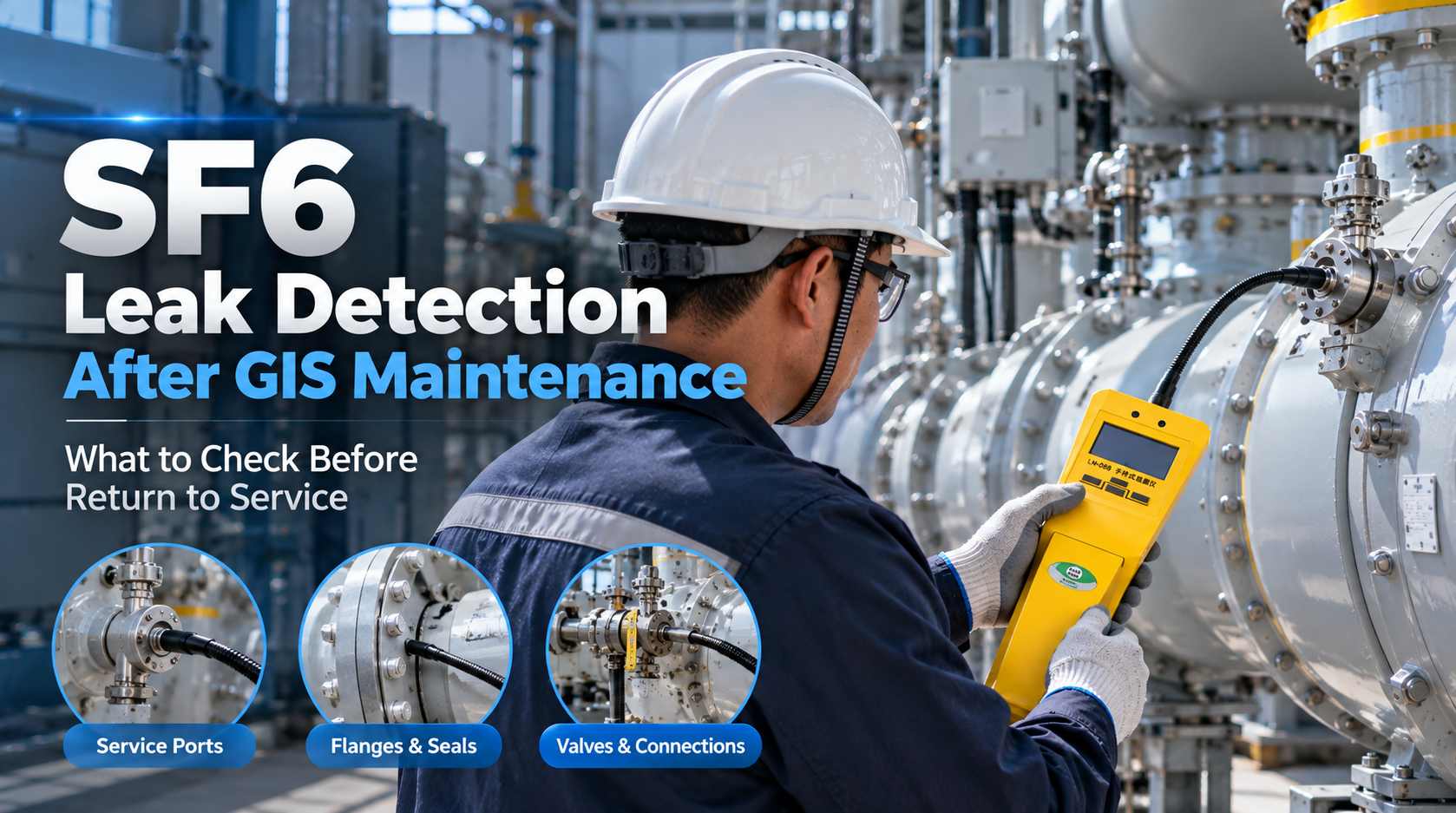
After GIS maintenance, start SF6 leak detection at connections that were opened, resealed, disconnected, or reconnected during the work.
Check service ports, valves, flanges, couplings, seals, and hose connection points before returning the GIS to service.
Follow the equipment manufacturer’s instructions, maintenance procedure, and project requirements for the inspection method and acceptance criteria.
Identify the Areas Serviced During Maintenance
Start by identifying every gas connection disturbed during the maintenance work.
Typical test points include:
- Filling and recovery ports
- Service valves and valve connections
- Flange joints
- Couplings
- O-rings and gaskets
- Sealing surfaces
- Hose connection points
SF6 leak detection should focus first on locations that were opened, resealed, or reconnected during maintenance.
This keeps the inspection focused on the connections disturbed during the work.
Prepare the SF6 Leak Detector
Check the SF6 leak detector before starting the inspection.
Confirm that:
- The instrument is operating normally
- Calibration is current, where required
- Battery level is sufficient
- The probe is clean and undamaged
- The zero or baseline reading is stable
- The correct measurement mode or sensitivity is selected
Detector sensitivity, response time, and sampling method can affect the inspection result.
Follow the detector manufacturer’s instructions for instrument setup and field use.
Check Service Ports and Valves First
Service ports and valves are directly involved in SF6 handling and should be checked early in the inspection.
Check:
- Filling ports
- Recovery ports
- Service valves
- Valve connections
- Protective caps
- Recently reconnected fittings
Move the probe around the full connection area when possible.
A systematic inspection helps identify localized changes in SF6 concentration and reduces the chance of missing a serviced connection.
Check Flanges, Couplings, and Seals
Next, inspect mechanical connections disturbed during maintenance.
Focus on:
- Flange joints
- Couplings
- Gaskets
- O-rings
- Sealing surfaces
- Fittings that were loosened or retightened
Move the probe slowly along the sealing line.
Do not sweep quickly across the connection. The detector needs enough time to sample the gas near the test point and respond to changes in concentration.
Keep the Probe Close to the Test Point
Probe position affects SF6 leak detection.
Keep the probe close to the connection or sealing area while keeping the probe inlet clear.
During inspection:
- Move the probe slowly
- Follow the sealing line
- Keep the probe inlet open
- Avoid pressing the probe against the surface
- Allow enough time for the detector to respond
Keep the probe position and movement consistent when comparing nearby test points.
Check Airflow and Background SF6
Air movement and residual SF6 can affect detector readings.
Possible influences include:
- Outdoor wind
- Indoor ventilation
- Residual SF6 from recent maintenance
- Nearby filling or recovery work
- Elevated background SF6 concentration
Strong airflow may carry SF6 away from the test point. It may also move residual gas from another location toward the detector.
If site procedures permit, avoid testing in strong local airflow. Do not disable required ventilation or safety systems.
If the background SF6 level is elevated, allow conditions to stabilize before repeating the measurement.
Confirm Abnormal SF6 Leak Detection Readings
One elevated reading does not always confirm a leak.
If the detector responds abnormally:
- Repeat the measurement at the same point.
- Check the surrounding area.
- Compare readings at nearby locations.
- Return to the original test point.
- Confirm whether the response is localized and repeatable.
A localized, repeatable increase at the same test point provides stronger evidence of a leak than a single abnormal reading.
This helps separate a possible leak from background SF6, residual gas, or changing airflow.
Recheck the Area After Repair
After repairing or resealing a confirmed leak, inspect the same location again.
Check that:
- The repair is complete
- The same test point has been rechecked
- The result meets the applicable acceptance requirement
- The recheck result has been recorded
The inspection is not complete until the repaired point has been verified.
A practical field workflow is:
Detect → Confirm → Repair → Recheck
Record the SF6 Leak Detection Results
Record the inspection results according to the maintenance procedure.
Useful information includes:
| Record Item | What to Document |
|---|---|
| Inspection location | Valve, flange, port, coupling, or other test point |
| Detector | Instrument used for the inspection |
| Test result | Reading or inspection result |
| Leak location | Confirmed leak point, if found |
| Corrective action | Repair or resealing performed |
| Recheck | Result after corrective action |
| Identification | Date and GIS equipment ID |
Accurate records provide traceability and support future inspection and maintenance.
Complete Leak Detection Before Returning GIS to Service
Before returning the GIS to service, confirm that:
- All required test points have been inspected
- Abnormal readings have been verified
- Confirmed leaks have been corrected
- Repaired points have been retested
- Results have been recorded
- Applicable acceptance requirements have been met
Perform the required leak checks according to the equipment manufacturer’s instructions, maintenance procedure, and project requirements.
Once the required checks are complete and the results meet the applicable requirements, the GIS can be returned to service.
For GIS maintenance, select a portable SF6 leak detector based on the required sensitivity, measurement range, response time, sampling method, and field conditions.
FAQ
Where should SF6 leak detection start after GIS maintenance?
Start with connections disturbed during the work, including service ports, valves, flanges, couplings, seals, and hose connection points.
Does one abnormal detector reading confirm an SF6 leak?
No. Repeat the measurement and compare nearby readings. A localized and repeatable response provides stronger evidence of a leak.
Can airflow affect SF6 leak detection?
Yes. Wind or ventilation can move SF6 away from the leak source or carry residual gas toward the detector.
Should a repaired leak point be tested again?
Yes. Recheck the same location after repair and confirm that it meets the applicable acceptance requirement.
What should be recorded after an SF6 leak check?
Record the inspection location, detector used, test result, confirmed leak point, corrective action, recheck result, date, and equipment identification.