How Does Gas Volume Affect SF6 Equipment Selection?
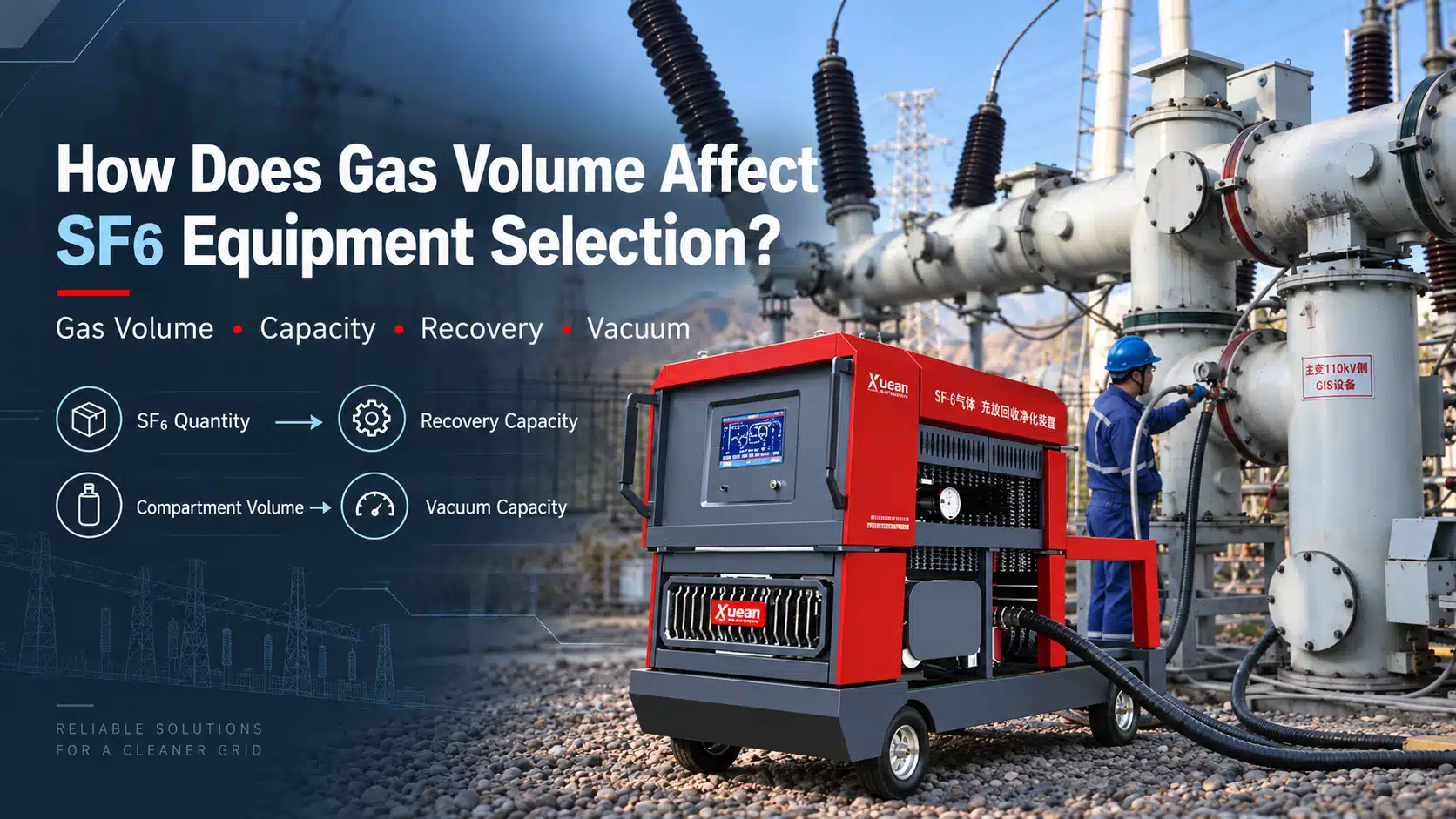
Gas volume is a key factor in SF6 equipment selection because it affects equipment capacity, processing time, storage requirements, and system configuration.
Two values need to be separated:
- SF6 quantity: the amount of gas to recover, store, or fill
- Gas compartment volume: the internal space that must be evacuated
These values affect different parts of the gas-handling process. SF6 quantity mainly affects recovery, filling, and storage. Gas compartment volume mainly affects vacuum pump selection.
Understanding this difference is the first step in selecting the right SF6 gas equipment.
Distinguish SF6 Quantity from Gas Compartment Volume
SF6 quantity is usually expressed as mass, typically in kilograms. It tells you how much SF6 must be transferred during maintenance.
Gas compartment volume refers to the internal volume of a GIS compartment, switchgear enclosure, or other gas-insulated equipment.
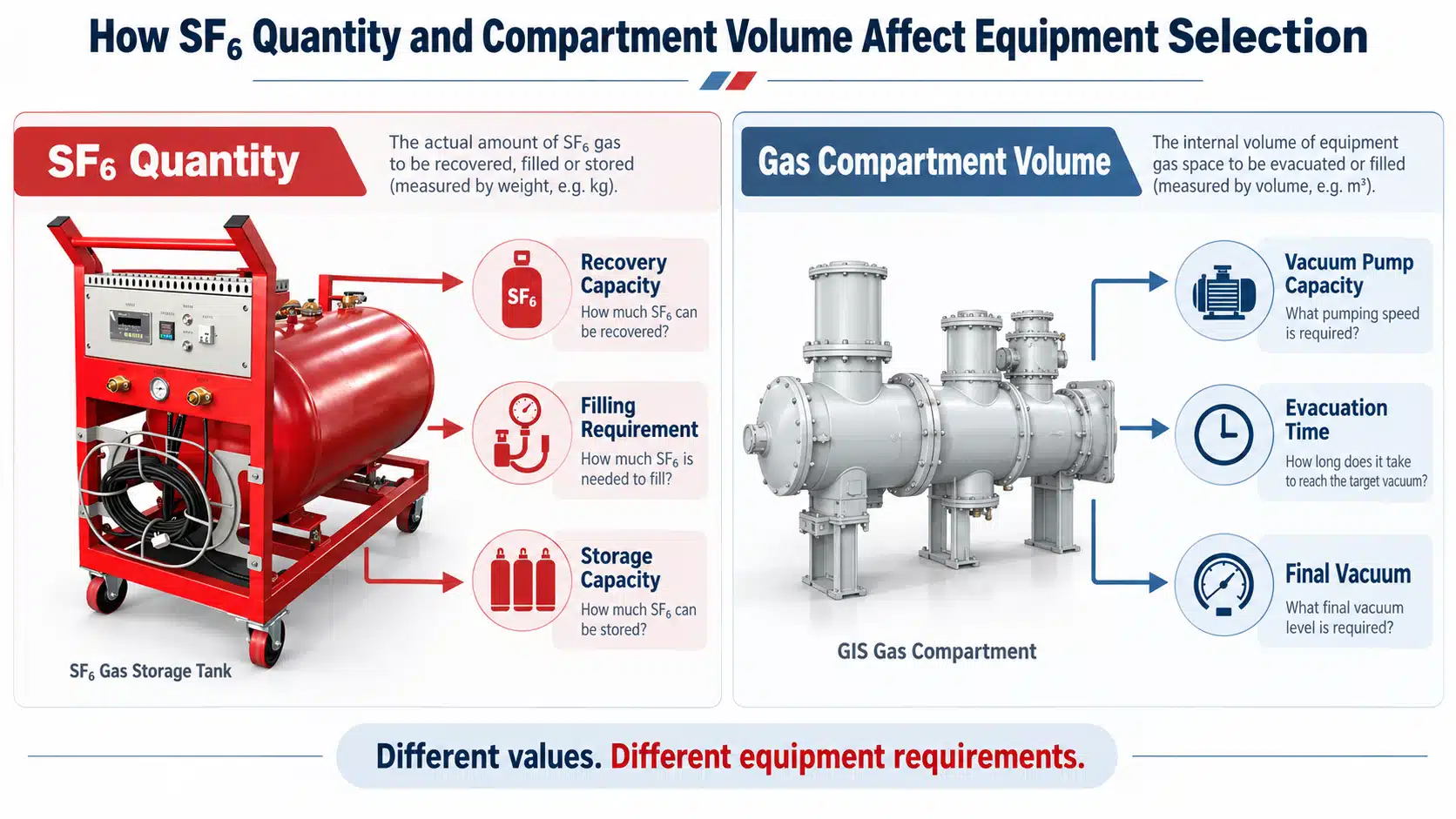
The distinction matters because recovery and evacuation are different operations.
| Selection Value | Main Effect |
|---|---|
| SF6 quantity | Recovery, filling, storage |
| Gas compartment volume | Vacuum evacuation |
| Both | Processing time and system configuration |
Using the correct value for each process helps avoid incorrect equipment sizing.
For this reason, SF6 equipment selection should not be based on a single gas-volume figure.
SF6 Quantity Affects Recovery Capacity
The amount of SF6 determines the total recovery workload.
As the SF6 quantity increases, the recovery system must handle more gas within the available maintenance time. This affects:
- SF6 recovery capacity
- Compressor performance
- Storage capacity
- Recovery time
- Hose configuration
A small service job and a large GIS project may require different SF6 gas equipment capacities.
More SF6 does not automatically mean choosing the largest recovery unit. In SF6 equipment selection, the required capacity depends on how much gas must be recovered and how quickly the work must be completed.
Recovery Time Also Affects Equipment Size
Gas quantity alone is not enough to size recovery equipment.
Two projects may each require recovery of 100 kg of SF6. One may allow four hours for the work, while the other may have a much shorter maintenance window.
They may therefore require different SF6 recovery capacities.
Key factors include:
- SF6 quantity
- Initial pressure
- Required final recovery pressure
- Available recovery time
- Operating frequency
A more useful question is:
How much SF6 must be recovered within the required time?
This gives a clearer basis for sizing the recovery system than SF6 quantity alone.
Gas Compartment Volume Affects Vacuum Pump Selection
Recovery removes SF6 from the electrical equipment.
Evacuation removes air and residual gas from the compartment before filling.
Because these are different processes, recovery capacity and vacuum pump capacity should be evaluated separately.
Vacuum pump selection depends on:
- Gas compartment volume
- Pumping speed
- Required final vacuum
- Available evacuation time
- Hose diameter
- Hose length
A pump that works well on a small compartment may take much longer to evacuate a larger one.
Gas compartment volume is therefore an important input in SF6 equipment selection, especially when sizing the vacuum system.
SF6 Quantity Affects Filling Requirements
The amount of SF6 also affects filling time and gas-transfer requirements.
Key factors include:
- SF6 quantity
- Target filling pressure
- Required filling time
- Gas source
- Hose configuration
- Flow control
Larger SF6 quantities require more gas to be transferred, but quantity alone does not determine the filling configuration.
Target pressure, flow rate, and available filling time also matter.
The filling system should be sized as part of the overall SF6 gas equipment configuration, not as a separate process.
Storage Capacity Must Match the Recovery Task
Recovered SF6 needs enough storage capacity.
If the available storage is too small, the operator may need to stop recovery, change storage vessels, or divide the job into several stages.
Before sizing the storage system, confirm:
- Expected recovered SF6 quantity
- Number of compartments to be serviced
- Internal or external storage
- Storage vessel rating
- Operating conditions
Storage capacity should match the expected gas quantity and the permitted operating conditions of the storage system.
For larger SF6 gas volumes, recovery capacity and storage capacity should be evaluated together.
Hose Configuration Can Limit Gas Flow
The main unit is only one part of the gas-flow path.
SF6 must also pass through hoses, valves, fittings, and connectors. These components can restrict flow and reduce field performance.
Important factors include:
- Hose diameter
- Hose length
- Connector bore
- Valve restrictions
- Number of connections
This matters more when higher flow rates are required.
A high-capacity recovery unit cannot deliver its full performance through a restrictive flow path.
Hoses and connections should therefore be included when sizing the complete SF6 gas equipment system.
More SF6 Does Not Always Mean a Larger Unit
Higher capacity is not always the best choice.
Larger equipment may also require:
- More floor space
- More electrical power
- More difficult transport
- Better site access
- More handling equipment
For mobile service work, portability may matter more than maximum capacity.
For a large GIS project with a short outage window, higher capacity may be more important.
The goal is to match SF6 equipment capacity to the job, not to select the largest available unit.
Consider Gas Volume Along with Other Selection Factors
Gas volume is an important starting point for SF6 equipment selection, but it should not be used alone.
Other operating conditions also affect the final SF6 gas equipment configuration.
| Selection Input | Main Effect |
|---|---|
| SF6 quantity | Recovery, filling, storage |
| Gas compartment volume | Vacuum pump sizing |
| Initial pressure | Recovery conditions |
| Final recovery pressure | Recovery requirement |
| Required final vacuum | Vacuum requirement |
| Required processing time | Equipment capacity |
| Hose length and diameter | Flow resistance |
| Connection type | Compatibility |
| Power supply | Electrical configuration |
| Site access | Equipment size and mobility |
Together, these values provide a better basis for selecting and configuring SF6 gas equipment.
Match Equipment Capacity to the Job
For recovery and filling, start with the SF6 quantity and required processing time.
For evacuation, start with the gas compartment volume, required final vacuum, and available evacuation time.
Then check pressure requirements, storage capacity, hose configuration, power supply, and site conditions.
Effective SF6 equipment selection starts with the actual gas-handling task rather than maximum equipment capacity.
Before requesting an SF6 gas equipment quotation, provide the supplier with the SF6 quantity, gas compartment volume, pressure requirements, required processing time, hose configuration, power supply, and site conditions. This information helps match the equipment capacity and configuration to the maintenance task.