What Can You Earn from SF6 Gas Equipment?
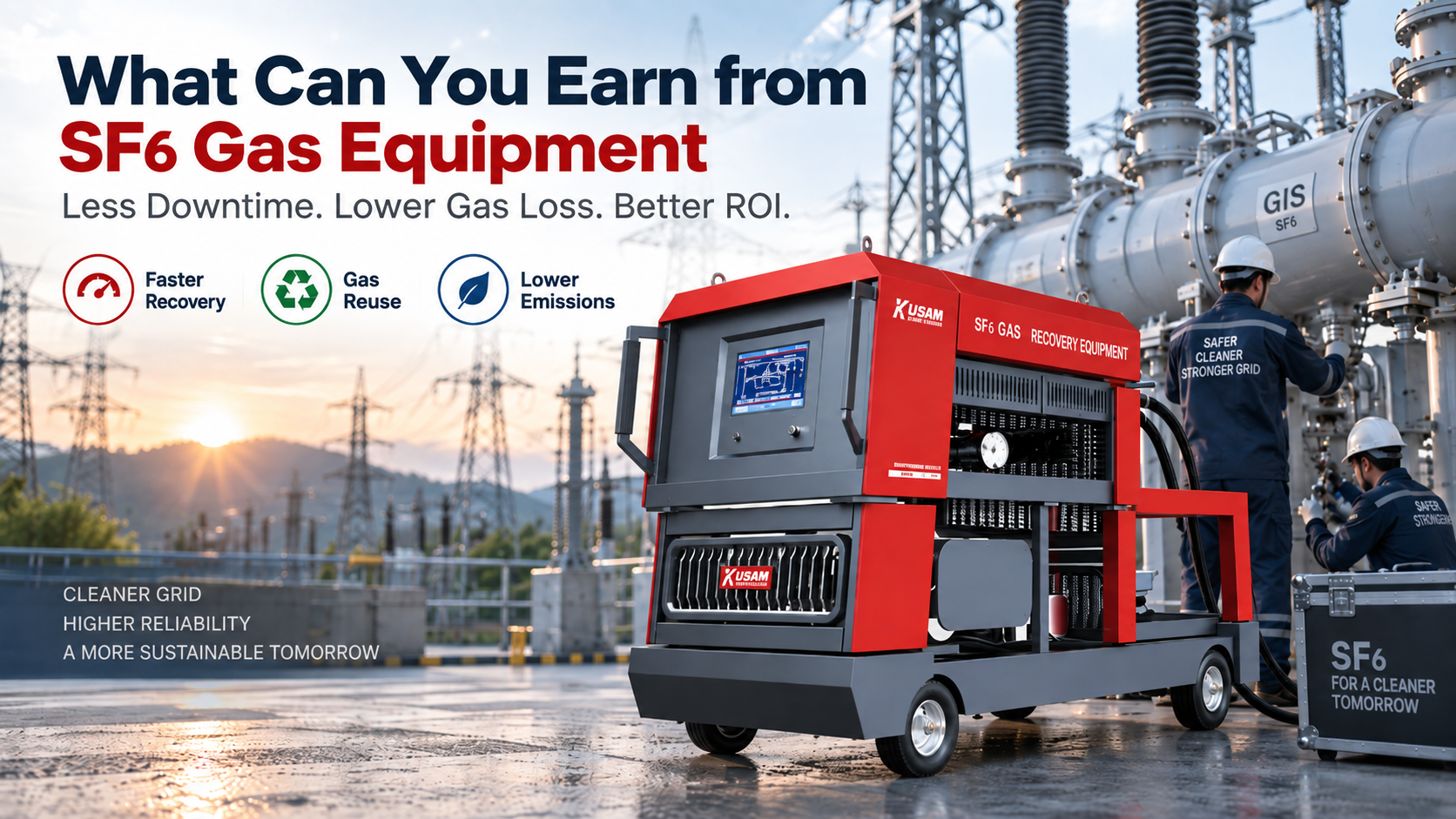
Is SF6 gas equipment just another expense, or does it actually pay you back?
For utilities and service companies, SF6 gas equipment can lower maintenance costs in several ways. Faster recovery reduces downtime. Gas recovery and reuse reduce new-gas purchases. Automation cuts manual work, while leak monitoring and gas analysis help control losses and protect electrical equipment.
Purchase price is only one part of the equation. What matters more is the annual cost of your current SF6 handling process.
Time Saved – Less Downtime, More Uptime
SF6 recovery can affect the length of a maintenance outage.
Before GIS or circuit breakers can be opened, the gas usually must be recovered. Slow recovery extends the job.
A properly sized recovery system shortens this step.
For large gas volumes, the RF-391 Mega Series SF6 Gas Recovery Equipment provides the capacity needed for GIS, substations, and other high-volume applications.
Faster recovery can provide:
- shorter maintenance windows;
- less equipment downtime;
- better use of service crews;
- more work completed within the same schedule.
Automation saves additional time.
PLC control, automatic valve operation, and preset operating sequences reduce manual intervention. Operators spend less time switching valves and monitoring each stage.
The result is fewer labor hours per job and better use of maintenance crews.
Gas Saved – Reuse Instead of Buying New
Recovered SF6 still has value.
Gas lost during maintenance must be replaced. Gas that is recovered, tested, and properly processed may be reused.
The calculation is simple:
More gas recovered = less new gas purchased.
Recovering more gas directly reduces replacement-gas costs and improves overall SF6 recovery system savings.
Recovered gas may contain moisture, air, decomposition products, oil, particles, or other contaminants. Its quality must be checked before reuse.
IEC 60480 provides criteria for evaluating recovered and reclaimed SF6 for reuse in electrical equipment.
If the gas does not meet the required limits, purification or regeneration may improve its condition.
The RF-300J SF6 Gas Recovery and Purification Unit supports this process.
A typical workflow is:
Recovery → Purification or Regeneration → Analysis → Reuse
Regeneration alone does not make the gas ready for refilling. Testing must confirm that it meets the required reuse criteria.
Qualified gas can then return to service, reducing the need for new SF6. This is the main SF6 gas recycling cost benefit.
Money Saved on Labor
Manual SF6 handling takes operator time.
Technicians may need to switch valves, monitor pressure, change operating modes, and supervise each stage.
Automation reduces that workload.
PLC-controlled systems can automate more of the recovery, evacuation, and gas-transfer process, reducing:
- manual valve operation;
- operator-hours;
- operating errors;
- repeated work;
- overtime.
Staffing still depends on site procedures and safety requirements. However, fewer manual steps generally mean less hands-on work per job.
Labor savings should be part of any evaluation of the benefits of SF6 recovery equipment.
Safety and Compliance – Reduce Emission Risk
SF6 is a regulated greenhouse gas, and emission controls continue to tighten in many markets.
Utilities and service companies need reliable methods to limit leaks, recover gas during maintenance, and track SF6 use.
Leak monitoring supports these requirements.
The NA1000MS SF6 Leak Monitoring System provides continuous monitoring where early leak detection is important.
Early detection can reduce:
- SF6 loss;
- repeated refilling;
- emergency maintenance;
- compliance risk.
After a leak is detected, a portable leak detector can help technicians locate the source.
Monitoring also supports safer maintenance when electrical equipment may contain SF6 decomposition products after a fault.
For operators with large SF6 inventories, effective leak control can prevent both gas loss and unplanned maintenance costs.
Equipment Life – Good Gas Quality Protects Your Assets
Recovered gas should be tested before reuse.
Moisture, air, and decomposition products can affect gas quality and may also indicate problems inside the equipment.
The RA912F SF6 Gas Quality Analyzer can measure key parameters such as:
- SF6 purity;
- moisture;
- decomposition products.
These measurements show whether the gas is suitable for reuse or requires further treatment.
Gas analysis also reduces the risk of returning off-spec gas to GIS or switchgear.
GIS and high-voltage switchgear are major capital assets. Checking gas quality helps protect those assets and may prevent avoidable maintenance problems.
Environmental Contribution – Reduce SF6 Emissions
SF6 has a very high global warming impact.
Using a 100-year GWP value of 23,500, releasing 1 kg of SF6 is equivalent to about 23.5 metric tons of CO2.
Even small gas losses can therefore have a significant climate impact.
Recovering and reusing SF6 keeps more gas in service and reduces emissions.
Recovery, recycling, gas analysis, and leak monitoring can help utilities:
- reduce SF6 emissions;
- increase gas reuse;
- support carbon-reduction programs;
- support environmental and ESG targets.
A practical SF6 management process follows four steps:
Recover the gas. Test it. Treat it when needed. Reuse it when qualified.
Proper SF6 gas equipment makes that process easier to control and reduces both operating costs and emissions.
What Does the Investment Return?
The value of SF6 gas equipment becomes easier to measure when the main savings are viewed together.
| Area | Without Proper Equipment | With the Right Equipment | Potential Value |
|---|---|---|---|
| Recovery | Longer recovery time | Faster gas transfer | Less downtime |
| Labor | More manual work | Greater automation | Lower labor cost |
| SF6 use | More replacement gas | More gas recovered | Lower gas purchases |
| Regeneration | Off-spec gas may be discarded | Gas can be treated and retested | More reuse potential |
| Gas analysis | Gas condition is unknown | Gas quality is verified | Better reuse decisions |
| Leak control | Leaks found late | Earlier detection | Less gas loss |
| Equipment protection | Off-spec gas may be reused | Gas is checked before reuse | Lower equipment risk |
| Environment | More SF6 emissions | More recovery and reuse | Lower climate impact |
What you earn from SF6 gas equipment
The return from SF6 gas equipment comes from several areas.
Faster recovery shortens maintenance time. Reusing qualified SF6 reduces new-gas purchases. Automation lowers labor hours. Leak monitoring helps prevent gas loss, while gas-quality testing helps protect GIS and switchgear.
A simple ROI calculation is:
Annual Savings = Gas Savings + Labor Savings + Downtime Savings + Avoided Service Costs
Compare that with:
Equipment Cost + Maintenance + Calibration + Training
For companies that handle SF6 regularly, these savings can make the investment worthwhile.
As SF6 regulations tighten and gas costs rise, efficient recovery, reuse, analysis, and leak control will become even more important.
Planning to purchase SF6 gas equipment or upgrade your current gas-handling system? Contact us at [email protected] for a quotation, equipment selection support, or a customized solution for your application.
FAQ
How long does it take to see a return on investment?
There is no fixed payback period.
ROI depends on SF6 volume, maintenance frequency, labor costs, gas losses, downtime, and replacement-gas costs.
Companies that handle SF6 frequently have more opportunities to recover the investment through repeated savings.
Can I recover SF6 without a recovery cart?
SF6 can be transferred using different systems, but dedicated recovery equipment provides better control over gas recovery, storage, evacuation, and transfer.
For routine utility maintenance, a recovery cart is usually the more practical option.
Is it cheaper to buy new SF6 or recycle old gas?
It depends on the condition and quantity of the recovered gas.
If recovered SF6 can be processed and meets the required reuse criteria, recycling can reduce new-gas purchases.
A more useful comparison is:
New SF6 cost vs. recovery + treatment + testing cost
As SF6 regulations tighten and gas costs rise, the value of owning the right SF6 gas equipment will continue to grow.